By dragging feet on metric system, US leaves world puzzled









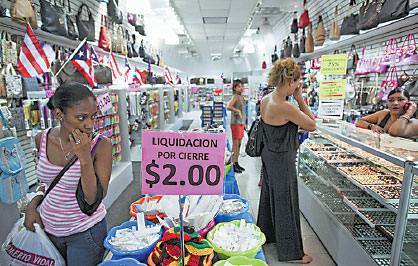 |
| People shop in a store in San Juan, Puerto Rico, on Monday. [Photo/Agencies] |
News from Puerto Rico is depressing these days as the United States Congress last week denied the beautiful Caribbean Island a bankruptcy bailout to overcome its deep debt. Unlike a formal US state, Puerto Rico, which became a US territory in 1898 following the US invasion during the Spanish-American War, is not allowed to declare bankruptcy.
Puerto Rico may be heading into default in 2016, but I have found a bright spot on the island during my recent trips there. Apart from the fact that most Puerto Ricans speak Spanish rather than English, the island is one of only two places in US territory where the metric system is used. The other is Guam, which the US also seized from Spain in 1898.
At gas stations in Puerto Rico, prices are listed as dollar per liter, unlike per gallon in formal US states. And to measure distance and weight, meters, kilometers, and kilograms are used instead of feet, miles, and pounds.
While these signs may make American tourists feel quite foreign in a US territory, it makes international travelers much more at home.
Despite having studied, worked and lived in the US for years, I still cannot figure out that 7-foot-5 actually means a 2.26-meter-tall guy like Yao Ming, and I have to do my math while filling out any form that requires my height in feet instead of meters.
The weather app on my iPhone is displayed in Celsius, instead of Fahrenheit, because I am still not quite numerically adept at telling the high of 57 F on Wednesday in New York is actually 16 C.
I am not the only one left confused with all the miles and pounds and Fahrenheits. Many Chinese and people from other countries traveling, studying, working or living in the US suffer the same predicament, as the US remains one of only three countries in the world to not have adopted the metric system. The other two are Myanmar and Liberia.
The US was one of the original 17 signatory countries to the 1875 Metric Convention, or the Treaty of the Metre. The US Congress in 1975 passed the Metric Conversion Act to coordinate and plan the increasing use of the metric system in the country, but so far progress has been extremely disappointing.
The United Kingdom, which invented the so-called Imperial System, has witnessed huge progress in using the metric system. Canada and Mexico, two neighbors and major trade partners of the US, also use the metric system. And Myanmar officials announced three years ago the government's intention to convert to the metric system.
A superpower and the world's largest economy like the US not adopting the metric system not only inconveniences international exchange and communications, but also leads to a huge waste of resources for foreign exporters tackling the US market or US exporters expanding in the global market, and certainly bad for fighting climate change.
I am not sure if any of the so-called high-level Trans-Pacific Partnership members has raised the adoption of the metric system as a criterion to reduce unnecessary barriers and costs of trade.
Lincoln Chafee, former Rhode Island governor who has dropped out of the 2016 Democratic presidential race, was probably the only candidate who campaigned for the US to go metric.
There is no doubt that the metric system has been and is the global rule and norm of the 21st century. It is also an area where the US has clearly fallen far behind.
The author is deputy editor of China Daily USA. chenweihua@chinadailyusa.com