'Pandemic' possible with H7N9 virus









|
Medical staff at Tangdu Hospital in Xi'an, Shaanxi province, give flowers to a man surnamed Guo last month. Guo recovered from bird flu after being treated at the hospital. The hospital is affiliated with the Fourth Military Medical University.Ruan Banhui / For China Daily |

Mutations could lead to worldwide catastrophe, Chinese study finds
A study published by a prestigious international medical journal has warned that mutations in the bird flu H7N9 virus could lead to a "pandemic" that could cause sickness and death around the world.
The study, led by Yu Hongjie and fellow researchers at Fudan University's Public Health Institute in Shanghai, is based on information from all lab-confirmed human cases of H7N9 reported in the Chinese mainland as of late February.
The findings were published in Lancet Infectious Diseases this month.
A surge in human infections with the latest outbreak in China has prompted pandemic concerns. The study aimed to describe the epidemiological traits of the virus and to estimate the risks, according to Yu.
In the study, virus samples collected in February from two human cases in Guangdong province were confirmed to have the mutation that made the virus capable of causing sickness and death in infected poultry as well.
China reported its first human H7N9 case in 2013, and outbreaks have occurred since then during the winter and spring.
Before the current outbreak, most infected birds did not show any symptoms, the study said. There has been no poultry vaccination against H7N9.
Notably, the number of human cases reported over the same period has more than doubled from previous epidemics, the study found, deepening concerns over mutations enabling the virus to easily jump between people - which could lead to a global spread.
Bernhard Schwartlander, China representative of the World Health Organization, told China Daily that the risk of human-to-human transmission is low, as the virus does not appear to transmit easily from person to person.
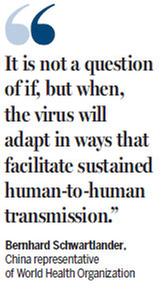
"However, experts agree that it is not a question of if, but when, the virus will adapt in ways that facilitate sustained human-to-human transmission," he warned.
It is imperative that policymakers in China identify a suite of immediate interventions, including live poultry market closures and poultry vaccination as a requirement for market access, he said.
Yu agreed, aes should be permanent.
Roughly 70 percent of infected patients reported live poultry exposure, mostly at the markets, the study found. More than 40 percent of the patients who were hospitalized died.
Schwartlander also urged Chinese authorities to remain vigilant and reinforce surveillance and control efforts to contain the virus.
Experts said well-cooked chicken is safe to eat.






- PLA Daily: China resolute in winning anti-graft war
- China unveils regulations on Party organization elections within armed forces
- Pick your own cherished flowers in downtown Shanghai
- Liangjiang New Area of Chongqing inaugurated
- 17 rescued Filipino crew members transferred
- Team of Chinese, US scientists identifies key tumor cell state driving cancer growth, drug resistance