



Green finance to help reduce pollution, boost industrial upgrading









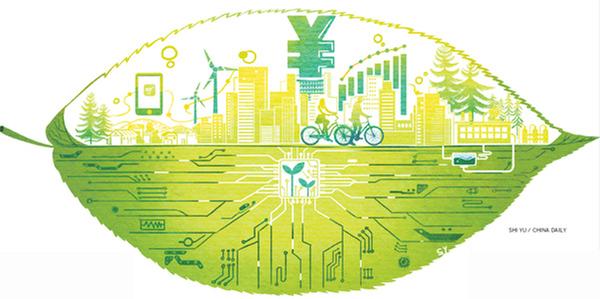
Move makes china the first country to build a national system to boost green finance
As China strives to protect its ecological integrity, the financial sector is coming to the aid to contain pollution and help advance the industrial transformation.
Green finance-a concept still unfamiliar to most-entered the economic lexicon last week after the central government decided to set up five pilot zones nationwide.
The State Council, China's Cabinet, arrived at the decision at an executive meeting, which was presided over by Premier Li Keqiang on June 14. Financial institutions will further enhance their shoring-up for environmental protection projects and industrial upgrading with favorable policies on interest payments and loans.
The pilot zones will be set up in Zhejiang, Jiangxi, Guangdong, Guizhou provinces and the Xinjiang Uygur autonomous region, according to a statement released after the meeting.
Systematical innovation for green finance will increase the financial sector's support to improve ecology and boost the efficient utilization of resources. The statement said the pilot zones are also an important way to continue China's commitment to the Paris climate accord after US President Donald Trump announced the US would withdraw from the agreement early this month.
The statement said the government will support financial institutions to set up green finance departments and welcome foreign capital to participate in green investments. The development of "green credit" will be encouraged to take the environmental credentials of companies into account. The country will start pilot markets for trading rights of resources such as water and energy. The central government will provide support in fiscal, tax and land policies for green industries and projects, while a risk prevention mechanism will be established.
Green finance was first proposed in the Government Work Report delivered by Li in March 2016. The term, reiterated by the premier in this year's work report, was first officially defined in a guideline co-released by the National Development and Reform Commission and another six ministries in August. By definition, it means financial services that help increase investment and financing, project operations and risk management in fields such as environmental protection, energy conservation, clean energy, green transport and buildings.
The guideline made China the first country where the central government boosts green finance nationwide by building a national system, Chen Yulu, vice-governor of the People's Bank of China, the central bank, said during a policy briefing on Friday.
"The necessity to establish such pilot zones cannot be overestimated as the decision was the first concrete measure to implement the guideline," said Wang Yao, president of the International Institute of Green Finance at the Central University of Finance and Economics.
The pilot zones have already industrialized, or are undergoing industrial upgrading, or are in far-flung and less-developed regions, Wang said. Experience and lessons can be absorbed from different conditions, which can easily adapt to other regions, he added.
"We still lack experience in the new green finance, which demands pilot reforms to find replicable practices in wider regions," the premier told the State Council meeting.
Chen said each of the pilot regions had different conditions. Zhejiang and Guangdong have developed economies and financial sectors, but are eager to upgrade their current development models. How to integrate the financial market with industrial upgrading will be a key for the two provinces, he said.
For example, the city of Huzhou in Zhejiang is already one of the country's five cities which have compiled a "balance sheet" of natural resources. Quzhou city has carried out a pioneering project for green credits, green bonds and industrial funds, Chen said. These advantages will facilitate the establishment of new pilot zones, he added.
In comparison, Guizhou and Jiangxi are less-developed economically, but possess rich resources for green industries. The two provinces are set to boost green finance on their way to a less-polluting model for economic growth, which will focus on modern agriculture, rural drainage systems and energy conservation.
Nevertheless, Xinjiang is an important gateway of the Belt and Road Initiative and will lay more emphasis on fields such as clean energy and high-end manufacturing, including solar power equipment, Chen said.
Lu Zhengwei, chief economist of the Industrial Bank Co Ltd, said each of the five regions has its own conditions while building a green finance system. By carrying out the project, China's green finance will proceed more easily with lessons learnt, he said.











