



Japan should repent its past before trying to become normal nation









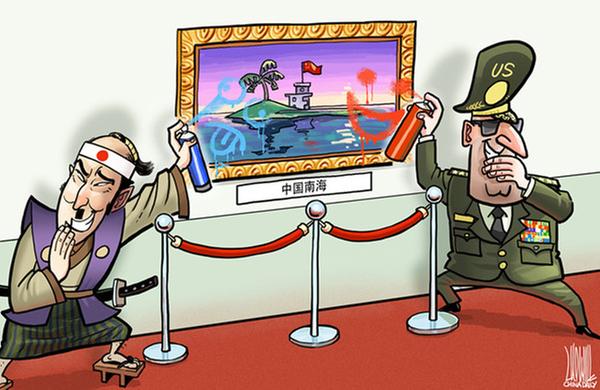 |
| South China Sea [Luo Jie / China Daily] |
Both incidents were interpreted by the international community as Japan's open defiance of China's so-called assertiveness in the waters. In fact, as soon as Japan announced that its biggest warship will disembark on a voyage to the South China Sea in May, its contentious military maneuverings were seen more as a provocation to China than deterrence against the Democratic People's Republic of Korea, as was claimed by Japanese officials.
In recent years, with Japanese Prime Minister Shinzo Abe clinging to his ultra-right, revisionist thinking, Tokyo has been constantly pushing the boundaries prescribed by its pacifist Constitution and creating a bigger role for its Self-Defense Forces to play both at home and abroad. Abe has even said he would amend the Constitution's war-renouncing Article 9 by 2020 so that the SDF is officially recognized as Japan's military.
Last year, the Abe administration ramrodded a controversial security bill through parliament, giving the green light to the SDF for the first time since the end of World War II to engage in armed conflicts overseas even when Japan is not under attack. Against this backdrop, the maneuvering of the Izumo symbolized a significant step for Japan in its efforts to fulfill the Abe administration's strategic ambition overseas. And to extend the tentacles of the SDF overseas, Japan has used its maritime dispute with China in the East China Sea and other regional disputes, such as those in the South China Sea, as a pretext.
Japan has nothing to do with China's maritime disputes with some ASEAN member states in the South China Sea. Yet it has developed a penchant for meddling in those disputes, which will disturb rather than build peace and stability in the region.
The activities of the Izumo in the South China Sea highlight Japan's intention to fish in troubled waters. Japan may try to consolidate its role as the "deputy sheriff" of the United States in the region by whipping up anti-China sentiments in the countries involved in the South China Sea disputes. In the process, it could also strengthen its hold in the region.
But despite all its machinations, Japan will ultimately realize that its ulterior intentions are nothing but wishful thinking.
Since US President Donald Trump's administration appears to lack interest in containing China's rise owing to its "America First" principle, the prospects for Japan to jump onto the US bandwagon to confront China now looks bleak. Besides, Japan's intention of driving a wedge between China and some ASEAN members over the South China Sea disputes is doomed to failure, now that China and the 10-member bloc have completed the drafting of a framework for the Code of Conduct in the South China Sea. The draft reflects the two sides' strong political will to resolve the maritime disputes through peaceful negotiation, and speaks volumes of the region's consensus on maintaining peace and stability in the South China Sea. And outside forces, be it Japan or some other country, cannot disrupt this process.
As for Japan's ambition of playing a bigger role in the region and beyond, it has already invited criticism for its rightist stance and actions. Japanese leaders should understand that before they truly repent for Japan's militarist past, any move to build up the country's military muscle will only be counterproductive.
The author is a senior writer with China Daily.wanghui@chinadaily.com.cn





