



China sees growth in financial talent









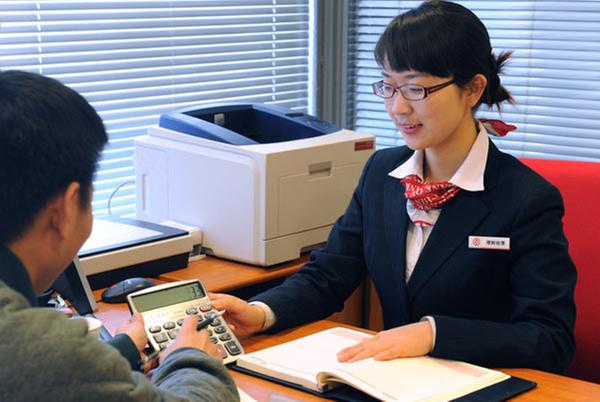 |
| An employee from the Bank of China introduces financial services to a client in Zhengzhou, Henan province. [Photo by Sha Lang/For China Daily] |
Chinese nationals represent more than 30 percent of candidates who sat for the Chartered Financial Analyst exam, the world's most recognizable financial credential, indicating the country's desire to increase financial talent and open up on a more global basis, according to a senior executive at the CFA Institute.
The nearly 4,000 charter holders in China are at least five years younger than the global average, reflecting their keenness to grasp the sets of knowledge and skills essential to landing and cementing a job with a relatively high threshold and financial return, said Nick Pollard, managing director of the organization's Asia-Pacific operation.
"China is a country really heavily investing in its talents. And because the credential is globally recognized, it shows China's openness of business to the rest of the world," he told China Daily.
CFA is a designation especially useful in the investment management profession. In order to obtain a certificate, the candidate needs to pass three levels of exams on a curriculum, from portfolio management to corporate finance, and an additional four years of relevant work experience.
While the majority of charter holders in China are concentrated in metropolises like Shanghai and Beijing, the landscape is quickly changing, with tier-two cities, including Hangzhou and Chengdu, seeing "exponential growth" in terms of financial talent, he said.
Pollard said the emergence of a variety of talent hubs in China was being driven by a number of factors, the most prominent being a string of supportive measures from local regulators, government and businesses to attract and retain financial specialists.
For instance, Shanghai has rolled out a number of preferential policies on home settling, medical and health insurance and people-to-people exchange programs to beef up its allure to financial professionals who have overseas study and work experience, said Wang Hua, chief of Shanghai's Lujiazui Financial City Development Bureau.
China's financial industry is maturing, with more professionals than amateurs joining the league. Financial talent-defined as those systematically trained with financial knowledge-in the country's securities sector jumped from 8 percent to 15 percent between 2010 and 2016, according to a survey published by the institute in early July.
"It's because compared with banking and insurance, securities has the biggest requirement for development and educational intervention, and regulators are used to understanding the need for professional education and certification needed (to do that job)," he said.
With new technologies such as artificial intelligence and big data dealing a blow to financial professionals, Pollard stressed a renewed focus on the "human touch" while nurturing talent. The Institute is also updating its curriculum to include financial technology elements to stay relevant and practical, he said.
"I don't see it as the end of personal advice, but a way of making efficiencies in analyzing data. But the communication and interpretation of that data, at least for now, is still going to be a human interaction between organizations and clients," he added.











