



Old school circuses struggle to survive after animal ban









As the secretary general of the Yongqiao Circus Association in Anhui province, Zhang Yongheng joked that he is constantly caught between the welfare of animals and human beings.
Seven years after the Ministry of Housing and Urban-Rural Development issued a guideline that banned Stated-owned zoos from hosting circus performances featuring animals, Zhang and his association have yet to find a solution to revive the century-old business.
Before the guideline was issued, a circus troupe that featured animals could rake in millions of yuan a year by touring the country, according to the association. Most of the performances took place in zoos.
An investigation by the State Forestry Administration later found that 53 zoos across the country were guilty of animal abuse during circus acts. This led the central government to ban the use of animals in such performances.
"The number of circus troupes has dropped from 400 at its peak to around 280 today," said Zhang.
"It's not that people are less interested, but animal rights supporters have been really fighting hard against such performances," he added.
Zhang's hometown, Yongqiao, was listed as China's first and only circus town by the central government in 2006. The town has a rich history of producing circus acts featuring animals since the Qing Dynasty (1644-1911). It is estimated that up to 80 percent of the circus artists in China hail from Yongqiao.
In an earlier interview with China Daily, Li Zhengliang, a Yongqiao native whose family owns a troupe, noted that all their circus animals are treated like one of their own.
"We have spent tens of thousands of yuan purchasing and raising them. We were counting on them for our livelihood. The last thing we would do is to hurt them," said Li.
Zhang argued that having animals in circus troupes is a more effective way of protecting them than leaving them in the wild where they might be killed by poachers.
"Chinese audiences still like to watch performances that have animals. The tradition in having such shows spans about 2,000 years," said Zhang, when asked if it is possible for a circus troupe to rely solely on acrobatics and human performances.
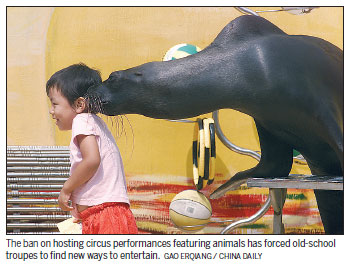
These days, circus troupes have no choice but to improvise in order to survive. Zhang said that some of the troupes actually dress their animals up in human costumes and have them walk on the stage for a few moments to grab the audience's attention. The majority of the performances is done by humans.
Zhu Lixin in Hefei contributed to this story.
(China Daily USA 07/21/2017 page8)


Today's Top News
- Asia's energy pain is far from over
- China-Africa ties moving toward higher-quality growth
- Governance powered by the goals of people
- Hainan consumer fair hits all the right notes
- Iran-US peace talks hang in the balance
- Nation's market seen as magnet for German firms





