How a desert branched out to become Beijing's guardian









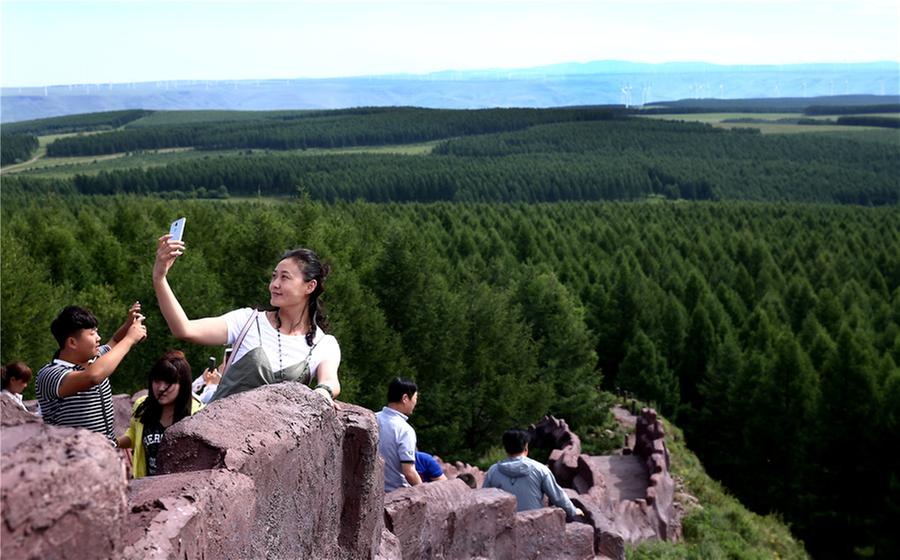 |
| A woman takes a selfie at Liangbingtai, a famous peak at Saihanba Forest Park in Hebei province.[Photo by Zou Hong/China Daily] |
In the early 1960s, the low survival rate of tree seedlings threatened the existence of the forest, but things began to improve in the spring of 1964.
"We wanted to make one last attempt," said Zhang Xing, 81, who has spent almost his entire life at Saihanba, as he stood on the fringes of a hoof-shaped patch of land in the northwest of the forest looking at the conifers that are now about 20 meters high. The trees, covering an area of 34 hectares, were all planted during that breakthrough spring.
"Two hundred people were in the mountains for 40 days continuously, preparing the earth for the planting of the seedlings, which took just two days," he recalled. "The trees were planted by specially adapted machines imported from what was then the Soviet Union. The roar of the machines mixed with the noise of the wind, and the dry earth, ploughed open by the machines, was swept up by the wind. The whole area was a battleground."
No battleground is without casualties.
"It was mid-April, but deep in the mountains winter was still battling for its last stronghold. We put on everything available, from cotton-padded overcoats to felt leg wraps. Ice formed on our clothes. It made a clunking sound with every move we made, turning our clothes into armor under which we sweated," he said. "Many of us, me included, developed severe rheumatism as a result."
When July arrived, the workers were overjoyed to discover a soft carpet of green shoots. That year, the survival rate topped 90 percent.
Chen Zhiqing, 45, who arrived in Saihanba in 1994, is the deputy director of the forest's management team. "The reason they failed in 1962 and '63 is because the tree seedlings they used were imported from other parts of China, especially the cold northeast. Saihanba's climate is so extreme that almost no 'outsider' could possibly survive. Moreover, long-distance transportation also resulted in the seedlings being damaged due to either severe loss of water or heat trapped inside the boxes," he said. "The seedlings planted in 1964 were all grown locally and had sturdy stems and robust roots.
"The cultivation method was changed, too: Before, mindful of the strong winds and scorching summer sun, the seedlings were put under shade. But no protected plant species could be expected to take root in Saihanba," he added. "So they eventually came up with what we now call all-light seedling cultivation, whereby the young plants, although still grown with lots of attention, were exposed to the elements."