Primary work starts at Baihetan dam









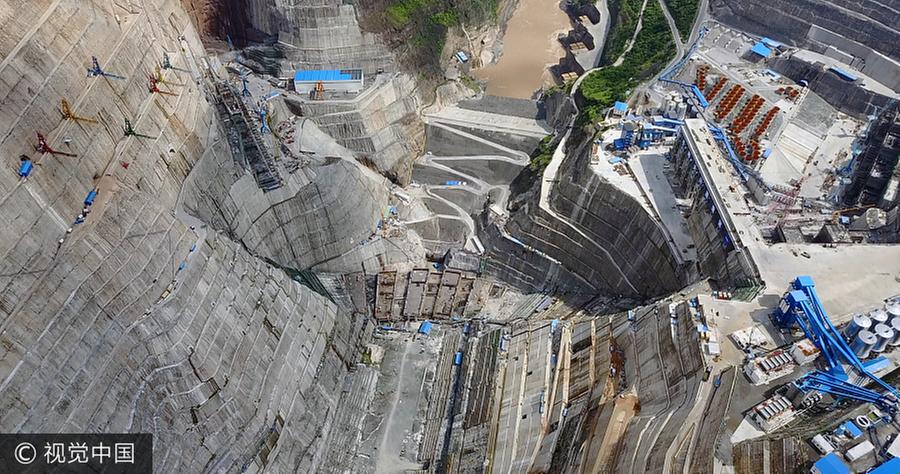 |
| Preparatory work for the Baihetan hydropower station, slated to be the world's second largest, is shown in Yunnan and Sichuan provinces on July 27.[Photo/VCG] |
Construction started on Thursday on what is to be the world's second-largest hydropower project, the Baihetan hydropower station, which is expected to enter operation by 2022.
It will be second only to the Three Gorges dam in terms of total installed capacity, weighing in at 16 gigawatts of capacity and an average annual output of more than 62 billion kilowatt-hours, according to China Three Gorges Corp, the dam's builder.
After six years of preliminary construction, the site is ready for the main project work, including building the dam and excavating underground tunnels, the builder said on Thursday.
Experts think the operation of the Baihetan dam, on the Jinsha River, an upstream branch of the Yangtze River, will substantially boost the share of hydropower in the country's energy mix while upgrading the power structure of the country's power grid.
China is rich in hydropower resources, and the Baihetan hydropower station will represent a good utilization of those resources while reducing greenhouse gas emissions caused by coal burning, according to Wang Hao, academician with the Chinese Academy of Engineering.
"While China is currently still relying on fossil energy, clean energy and renewable energy utilization will be an important direction for China's energy consumption in the future," Wang said.
"Hydropower development in the upper reaches of Yangtze River still has a lot of potential to be further tapped."
As a major west-to-east electricity transmission project and an important move to develop China's resource-rich but otherwise poor western region, the Baihetan hydropower station, spanning Yunnan and Sichuan provinces, will meet the demand for power in both provinces, while supplying power to the East China Power Grid, Central China Power Grid and China Southern Power Grid, corporation officials said.
The station, located in Ningnan county in Sichuan and Qiaojia county in Yunnan, will replace thermal power generating capacity of more than 62.44 billion kWh and 19.68 million metric tons of coal each year. It also will reduce emissions of carbon dioxide by 51.6 million tons, sulfur dioxide by 170,000 tons, nitrogen oxide by 150,000 tons and dust by 220,000 tons each year, officials said.
The dam is built on the main stream of the lower reaches of the Jinsha River, and while it is designed mainly for power generation, other functions include flood control, improvement of downstream navigation and development of transportation via water in the reservoir area.
To meet China's goals on energy conservation and emission reductions, the country intends to reach an installed capacity for hydropower of 380 gigawatts by 2020 as it seeks cheaper and cleaner alternatives to coal and weans itself off polluting fossil fuels.






- Dazzling Guangzhou lantern display begins countdown to Spring Festival
- Huizhou takes major step forward as petrochemical hotspot
- Beijing's Shunyi district cracks down on crimes related to public welfare
- Hunan's smoked fish and meat arrive in time for Spring Festival
- International arrivals to Guizhou skyrocket after visa-free policies
- Hubei deputy proposes museum of ancient Chinese law at Qin bamboo slip site