


Editor's note: In the lead up to the 19th Communist Party of China National Congress, China Daily reporters headed to northern Hebei and Inner Mongolia to see first-hand how measures implemented in the past five years are making China greener.
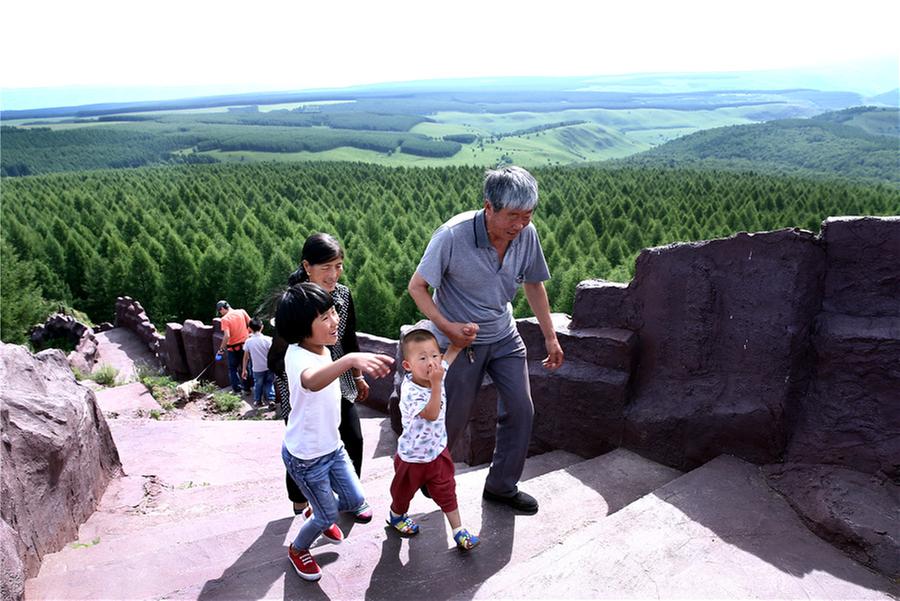 |
| Tourists visit Liangbingtai, a famous peak in Saihanba National Forest Park in Hebei province. [Photo by Zou Hong/China Daily] |
Thousands of trees form a natural barrier between the capital and sandstorms that blow in from the north
The distance between Chengde, Hebei province, and Saihanba National Forest Park, China's largest man-made woodland, is just 150 kilometers, but in September 1962, it took 18-year-old Yin Guizhi two days in an open truck to complete a journey marked by nonstop jolting and endless vistas of yellow soil dotted with thickets of trees.
"Having just graduated from a vocational school in Chengde, I asked to come here, together with two of my classmates. We were told the country was going to cultivate a forest, lush and beautiful. Just the thought of it was enough to get me onboard," said Yin, now 73.
She and her colleagues were warmly welcomed and treated to what the locals called black flour buns. Impressed more by the hospitality than the food, Yin had no idea what was to come a month later, when winter began.
"We lived in improvised shelters propped up on tree trunks and covered with twigs and straw. The glassless windows were covered with paper, and in place of doors we used large planks of wood that left big gaps on both sides," Yin said. "That was where we entered and exited our shelters, and where the winter winds came howling in."
Occasionally at night, a sleepless Yin caught glimpses of the glinting green eyes of wolves, which prowled around the shelters but didn't try to enter.
Often on winter mornings, she woke to discover her felt blanket had frozen solid to the wooden bed and she had to use a shovel to scrape it off.
Little by little, a straw mat one of Yin's colleagues used to sleep on the earthen floor became increasingly damp, indicating that the frozen ground was thawing and meltwater was seeping through.
"I felt that the debilitating cold was not only biting my toes, on which I applied soothing mashed potato, but also gnawing at any warmth I managed to retain in my heart," Yin said. "Again and again, I looked back to that vivacious young woman who just a few months before had believed she was here to stay. I tried desperately not to let reality snuff out that precious flame of hope."
For those who were at Saihanba, which means "beautiful highland", in 1962 and'63, the first two years of its existence, clinging to hope meant not only facing up to the harsher side of nature, but also to repeated failures.
More than 90 percent of the seedlings planted in those first two years died.
Saihanba, which covers 92,000 hectares and borders the southern edge of the Inner Mongolia autonomous region, was so volatile and untamable that people had forgotten that it was once regarded as one of the most beautiful places on Earth.





