



Symbols of fascism have no place in our society









The crimes the Nazis and Japanese forces committed against humanity will continue to remind us to never let down our guard
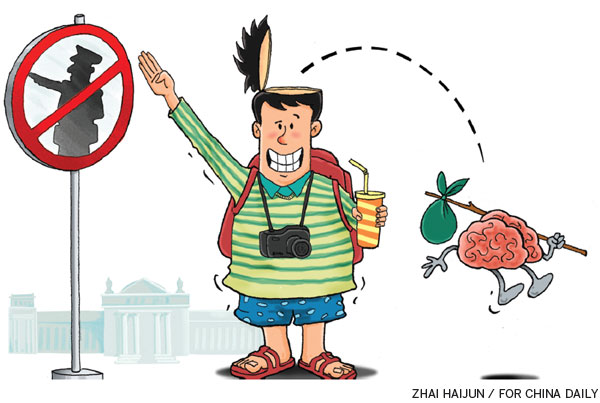
Two Chinese tourists were detained in Berlin for giving a Nazi salute while posing for photographs in front of the Reichstag parliamentary building on Aug 5. Three days later, the Shanghai Sihang Warehouse Anti-Japanese Aggression Museum issued a statement criticizing four Chinese youths for wearing Imperial Japanese Army uniforms and posing for photos in the warehouse, which Chinese forces successfully defended against the Japanese invaders in late 1937, and calling their act "impudent blasphemy".
The youths are citizens of a country where more than 35 million people died or were injured in World War II and have, inadvertently or otherwise, reopened old wounds.
The world has undergone radical changes since those days of endless horror. And almost everything has changed, from the interiors of homes to the exteriors of buildings, from our modes of transportation to the way we shop. Perhaps the only thing that has not changed is that every society has its taboos - some religious, some historical. And every society objects to the breaking of those taboos.
In many cases, it is what we oppose, not what we support, that determines who we are. A posture or a set of clothes may be right in one society but taboo in another culture, because humans, depending on their histories and cultures, have their own objects of reverence and set of taboos.
The hands of the clock continue to move, signaling the changing of time, but the wounds of history and those who caused those wounds should never be forgotten. That's why the tourists' and youths' actions cannot be attributed to their ignorance about German laws or their shallow understanding of their own country's recent history, especially because they occurred at historical spots.
The actions of the youths should bring to mind what happens at the Yasukuni Shrine in Tokyo, where Japan's "war heroes" since the Meiji Restoration in the late 19th century, including 14 Class A war criminals of World War II, are honored.
People wearing Imperial Japanese Army uniforms can often be seen swaggering in and around the shrine as a way of paying obeisance to the Japanese "war heroes" and "true patriots" - in other words, warmongers.
The Germans, on the other hand, have banned all symbols of Nazism and declared such actions a criminal offense. They have rebuilt their nation by condemning the atrocities committed by the Nazis and have put in place strict laws to punish people who use such symbols, whatever the reason. As such, Germany's resurrection within the international community is complete.
In contrast, Japan has not even initiated a process of introspection, although it is known as the land of Zen that is focused on meditation or dhyana, which in Sanskrit means a series of cultivated states of mind that lead to the "state of perfect equanimity and awareness". One wonders how can the Japanese attain that "perfect" state without introspection.
Without officially atoning for its war crimes, Japan cannot become a normal nation. And if Japan assumes to be a normal nation by building a military, it will again pose a threat to regional and international peace.
The Nazi salute by the two Chinese tourists and the Japanese army uniforms that the four youths in Shanghai put on have been nailed to the shameful pole of history. The crimes the Nazis and Japanese forces committed against humanity will continue to remind us to never let down our guard against fascism and its symbols.
If the peaceful development over the recent decades weakens our memory of the horrors of fascism and wars, we might end up opening up old wounds or inflicting new ones in the 21st century.
The author is a writer with China Daily. Contact the writer at liyang@chinadaily.com.cn
(China Daily European Weekly 08/18/2017 page13)


Today's Top News
- Smearing speaks more about the smearer: China Daily editorial
- China, Mozambique upgrade ties to community with shared future in new era
- Xi meets special envoy of Lao leader Thongloun
- Xi says to work with Africa to address spillover effects of Middle East conflict
- Sowing protection of environment in young minds
- Second Chinese-built large cruise ship to sail soon





