



A tale of 22 women preyed on by Japan army









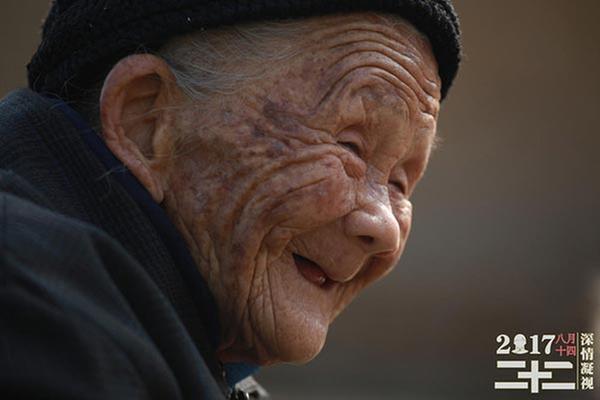 |
| A scene from Twenty Two. [Photo/Mtime] |
Twenty Two has already set many records for a documentary film. When the film's financer withdrew because its failure was almost "predictable", the director took the baton. When the filmmakers couldn't pay the distribution and publicity expenses, 32,099 people crowdfunded it through the internet. When it was not faring well on the cinema circuit, netizens "crowdfunded" it again, making it the fourth-most popular summer release, and raising its box office revenue to about 150 million yuan ($22.51 million) in 10 days.
Short three years ago, the documentary records the daily lives and memories of the last 22 women forced into sexual slavery by the Imperial Japanese Army during its occupation of China who were still alive on the Chinese mainland. There were about 200,000 such women in China.
About 4 million people have watched the film in cinemas, with many literally crying, but a greater number lost in thought in their seats only for the sweepers to bring them back to the present. For the audience, the film also provides some perplexing moments when the women sew self-mocking humor into the fabric of their stories-people cannot quite fathom how to react to such black humor.
How did the women endure the horrific crimes perpetrated by the Japanese invaders? How did they manage to fight back those unbearable memories throughout the rest of their lives? How did they live with the discrimination, even humiliation, strangers inflicted on them? Where did they get the strength to do so? These are some of the questions that people have been haunted by after watching the film.
Twenty Two acquires added importance because it could well be the last documentary on their lives, as 14 of the 22 women had passed away by the time the documentary was released on Aug 14, International Day for "Comfort Women". Perhaps that's why it has caught the imagination of the nation.
An outstanding feature of the 95-minute documentary is that it does not focus only on the women's heartrending memories, but attaches equal importance to recording their state of being at the time of the shooting.
The women send a clear message to the world through their plain discourse and composed smiles that they can live with the past, regarding it as a distasteful yet inalienable part of their lives.
A widowed farmer in Guilin, Guangxi Zhuang autonomous region, bow-backed Wei Shaolan, 93, lived with her 77-year-old "Japanese" son, whose biological father was one of her "violators" during her three-month "nightmare", in the remote mountains so that they could escape the taunts and humiliating comments of the people. They felt somewhat at peace, though neither said it openly, after many of the people who rubbed salt into their wounds had died over the past 70-odd years and none of the "violators", scores of them in one day, nor the Japanese government would turn up to apologize for their heinous crimes.
They harbor no hatred for anyone. At the end of the film, they pray for eternal peace between China and Japan, because "when war comes, people always die, be it Chinese or Japanese".
Now that the film has become a box office hit, many people have suggested changing "comfort women" to "sex slaves" subjugated by the Imperial Japanese Army. That may make sense, because the term "comfort women", coined by the Japanese to cover up their crime, could mislead many to believe these women ventured into it to earn a living, as the Japanese government still claims.
But these women have reached an age where they can neither memorize nor do they care about new terms. None of the 22 women in the documentary says "comfort women" in Chinese. They only use the Japanese term for that.
The author is a writer with China Daily. liyang@chinadaily.com.cn





