



Beware of temptation in cashless future









As the world starts to turn its back on paper money, one old golden rule still applies - don't spend it if you don't have it
China invented paper money more than a millenium ago during the Tang Dynasty (618-907), and Chinese innovators are now at the forefront of technological changes that could abolish cash for good.
With banknotes rapidly going out of fashion in the electronic age, China's Alipay just made it even easier for consumers to spend their money by rolling out facial recognition payments.
In the first commercial application of the technology at a fast food restaurant in Hangzhou, customers can now settle the bill by having their face scanned by a so-called "Smile to Pay" application.

It took hundreds of years for the concept of paper money to spread from China to the rest of the world, but the modern pace of technological uptake means facial recognition payments will not be confined to China for very long.
Just 50 years after the world's first cash dispenser was installed in suburban London, subsequent generations have become accustomed to dispensing with physical money almost entirely and using their charge cards for everything.
Barclays, the British high street bank that installed the first ATM, now allows customers to transfer money verbally via a voice application on their cellphones.
In theory, it doesn't much matter how we pay our bills, whether it is with gold coins, notes, electronic transfers, cards, cowrie shells or even smiles. The essential is that everyone has trust in the method of settlement.
Paper money only took off because traders were confident that they could safely deposit their gold and silver with China's national treasury in exchange for negotiable promisory notes.
When the traveler Marco Polo described the use of paper money to his medieval contemporaries, nobody believed him. It was to be centuries before the concept was adopted in Europe.
Some of today's older generation are similarly resistant to change and are horrified that one day cash may disappear altogether. Alarmed by tales of online scammers - the 21st century version of the pickpocket - many older people are reluctant to make payments online.
They also believe that the physical act of taking hard-earned cash out of your wallet and seeing it disappear into the shopkeeper's till makes it less likely you will make an impulse purchase with the simple wave of your card or your cellphone.
The existence of easy credit in many countries can also mean that consumers with a credit card burning a hole in their pocket end up spending money they don't have.
Recent research in Malaysia indicates that, while four out of 10 credit card holders pay their debt in full every month, 10 percent fail to make the minimum payment of 5 percent of the outstanding amount. So the method of payment, it turns out, can affect spending habits.
Others are concerned about leaving an electronic trail of their every purchase, an invitation to be pestered by marketers and advertisers, and prefer the anonymity of old-fashioned hard cash.
The anonymity of cash can, however, be exploited by tax-avoiders and money-launderers. Governments and monetary authorities, therefore, have an interest in the trend toward electronic payments that can be more effectively monitored.
However, with some retailers already promising - or should that be threatening? - to go completely cashless in years to come, recent research in the UK indicated that such a move could mean them losing up to half their customers, particularly the older ones.
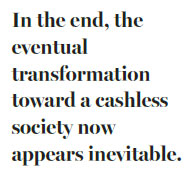
But, in the end, the eventual transformation toward a cashless society now appears inevitable.
That said, the old rules that have governed the use of money since it was first invented will remain in force: Beware of thieves and fraudsters, both in the real and virtual worlds; avoid impulse purchases of stuff you really don't need; and try not to spend money that you haven't got.
The author is a senior editorial consultant for China Daily.
Contact the writer at harveymorris@gmail.com.
(China Daily European Weekly 09/08/2017 page11)


Today's Top News
- China protests against the break-in at its embassy in Tokyo
- Decisive moments for energy renewables
- China pushes for using patents as innovation incubators
- China offers enabling climate for global firms
- Diplomatic solution to Iran crisis urged
- Trump cites talks, pauses strikes on Iran energy sites





