



Energy integration key to East Africa









To boost transformation of region over the next decade, gas pipeline and electrical grid link are among projects
East Africa shows signs of starting the same kind of structural economic transformation that Northeast Asia accomplished over the past 50 years, as countries in the region begin to develop the low-skilled manufacturing that many see as the key first step in the process. But Africa still has less than a 2 percent share of global manufacturing.
The African Development Bank reports that East Africa led the continent by far with 5.3 percent growth in 2016, and it predicts that high growth will continue. The bank sees regional integration as a key priority if Africa is to transform in the coming decade. The African Regional Integration Index found East Africa to be the most integrated region on the continent, with Kenya and Uganda leading integration. But Ethiopia and Tanzania lagged in regional links.
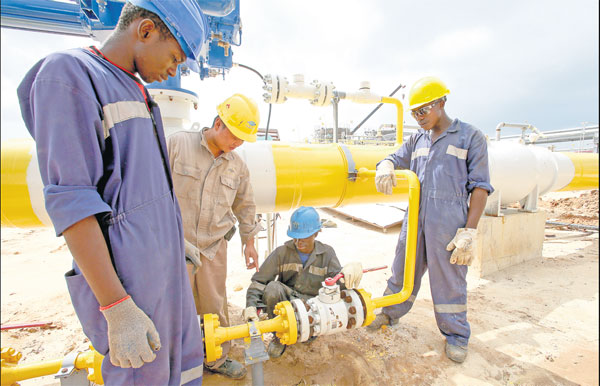
| Workers at a natural gas project construction site in Tanzania. Zhang Ping / Xinhua |
At a Sept 21 meeting at the United Nations, Ethiopian Prime Minister Hailemariam Desalegn said: "With an integrated industrial strategy, African states will hopefully mobilize funds, build the capacity of local employment and promote small (and) medium enterprises with domestic development projects."
The World Bank is funding the East African Power Pool to link the electrical grids of the region. A larger grid is especially important for green energy sources such as solar or wind power and also allows trade in hydropower throughout the region.
Ethiopia generates excess electricity, so in 2015 the country contracted with China Electric Power Equipment and Technology, along with Germany's Siemens, to build high-voltage transmission lines to Kenya. Similar power lines to Djibouti and Sudan are already complete.
Wondimu Tekle Sigo, former state minister at the Ethiopian Ministry of Water, Irrigation and Electricity, and now a graduate student at Peking University, says that Ethiopia is the "water tower" of East Africa - able to export hydropower throughout the region.
"We are promoting a green economy," he says. "We are integrating the region in terms of green development." He notes that the country was able to use internal savings to fund the $4.5 billion (3.8 billion euros; £3.4 billion) Renaissance Dam on the Blue Nile River.
Tanzania recently discovered huge natural gas deposits. However, current world energy prices are low, so the difficult process of exporting natural gas by liquefying it at very cold temperatures may not be economical. Furthermore, the "natural resource curse" shows that some nations that rely on petroleum exports are vulnerable to corruption and few have succeeded in industrializing.
So Tanzania plans to use its natural gas to power domestic industry. Also, in 2016, the development of a pipeline to Uganda that will allow efficient distribution throughout the region was announced. Cheaper electrical power and natural gas can help the region to develop manufacturing capability. According to a study by researchers at the London School of Economics, cheap natural gas from fracking has boosted US manufacturing exports by around 10 percent.
Yao Yang, dean of the Institute for South-South Cooperation and Development at Peking University, says: "Some of the East African countries have the real potential to be extraordinary - Ethiopia, Uganda, Kenya, Tanzania. One of the lessons they have learned from the 1990s is that they have had enough fighting. This time, Kenya just had an election, and the Supreme Court (annulled) the election, and both sides said, OK, let's do it again. They know they have to coexist peacefully. They have to focus on economic growth.
"Some countries have more discipline, like Uganda," says Yao. "Ethiopia is an ancient country that has been there for 2,000 years. I think the region has the potential to do really well in the next 10 to 20 years."
davidblair@chinadaily.com.cn
(China Daily European Weekly 10/06/2017 page8)


Today's Top News
- Weather risk warnings to get high-tech boost
- Increased stability in Sino-US economic ties urged
- Forum highlights opening-up, innovation
- US threatens attacks on Iran's power plants
- Innovation drives nation's EV success
- Future industries a 'concerto', not a 'solo', minister says





