



In the footsteps of my dynastic forerunner









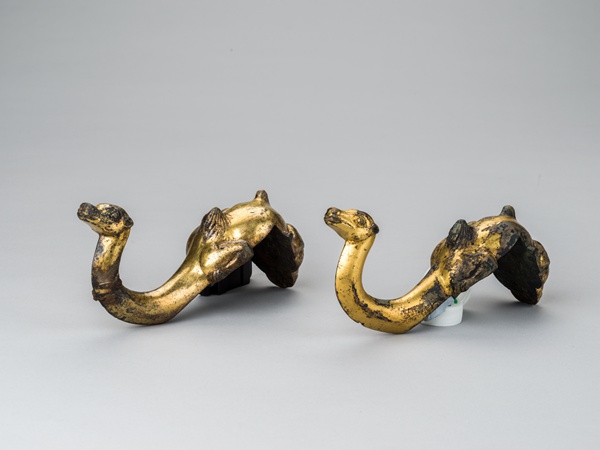 |
| Gilt bronze crossbow holders. [Photo provided to China Daily] |
The envoy was led by Zhang Qian, a man credited today with opening China's terrestrial Silk Road, a route that connected ancient China with central and western Asia, including what is now Iraq. The Hans paid great attention to the safety of the trade route, so much so that they repaired and maintained the Great Wall - a meandering defensive structure first built by Ying Zheng - at great cost.
The opening-up of the Silk Road brought two-way influences that can be glimpsed in the exhibition. Gilt bronze mat weights are embedded with gemstones including agate and turquoise, stones that probably came from outside China, Central Asia for example. The Han people liked to place themselves in a kneeling position when they sat down on the mat, and the weights served to keep the mat from moving.
This trade route, known also as the Desert Silk Road because it traversed large tracts of deserted land in what is now Gansu province, was augmented by others. Among them was a maritime silk road just starting to form. "We have on display crystal beads unearthed in today's Hepu county in the Guangxi Zhuang autonomous region, on China's southern coast," Shan says.
"Crystal as a natural material is not native to Hepu, and archaeologists believe the beads, dating back to the Han era, must have been brought from the South and Southeast Asia by sea."
A prominent decorative feature of the Han Dynasty involves the use of animal motifs. These are mostly animals from the northern prairie - deer, horses, tigers and bears. In these depictions there is often an element of tension either between two kinds of animals, or between animal and human being.
"The kingdom of Qin sits in what is now Shaanxi province, abutting the Inner Mongolia autonomous region," Shan says. "The conquering of the kingdoms of Zhao and Yan, located to its east and northeast, about 222 BC meant that Qin now shared a more extensive border with the vast grassland to its north, land dominated by steppe culture. Over time this culture insinuated its way first into Qin the kingdom and then the empire. The seepage continued throughout the Han Dynasty."















