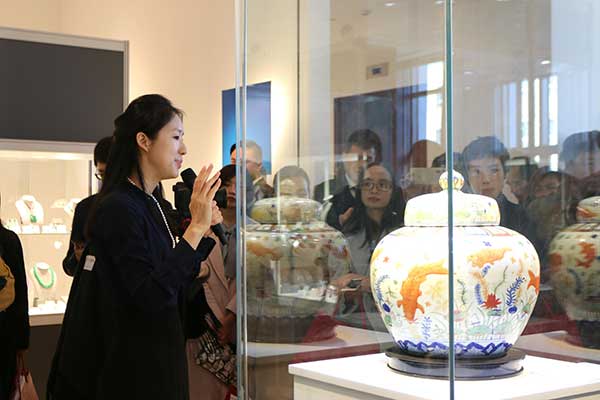
Chen says when Emperor Jiajing was on the throne, porcelain makers improved their skills and developed kilns capable of firing larger wares in more vivid colors such as the fish jar, which stands at 46 centimeters.
The primary artistic radiance of this jar lies in how the artisans found ways to make the fish look so true to life.
"In real life, red carp would have an undertone of yellow, especially when they swim and reflect the light," says Lyu Chenglong, a porcelain expert at Beijing's Palace Museum.
Artisans applied a layer of yellow enamel and above it, another layer of iron red enamel.
Lyu says the artisans needed to be very careful when applying the color and firing, to prevent the two colors from covering each other entirely.
"The eight fish are harmoniously arranged in a simple composition. And people always see a delightful scene when looking at the jar from different angles," he adds.
"Artisans didn't paint water or waves. It wasn't necessary, because the fish and the weeds look so lively."
Chen says the complex blend of red and yellow enamels also carry an auspicious message that "the emperor's good fortune is as vast as the heavens".
She adds that the pattern also relates to Jiajing's religious beliefs as a devout Taoist.
"Fish often represent an ideal state of being in Taoism. Plus, the emperor claimed himself 'a fisherman of the heavenly pond'."
She adds that the use of complementary colors is evident on the jar - the contrasts between red and green and between organic hues and blue - recalling a similar technique adopted by Western artists such as Henri Matisse (1869-1954).
The spherical shape and the rich palette used in the fish jar required not only excellence in technique but sometimes, a bit of good luck.
"A major difficulty of porcelain making is the firing process, which is not determined by man's will," says Lyu.
He says that no matter how well-designed an object's pattern and shape are, unpredictable changes will occur after it is sent into the kiln for firing. This is why a refined porcelain ware such as the fish jar becomes so sought-after among collectors.
He says dozens of similar fish jars are held in art museum collections both at home and abroad, including the Palace Museum, the Asian Art Museum in San Francisco and the British Museum in London.
Lyu adds that the production of fish jars reflects the economic boom that began in the mid-Ming period, and an accumulation of wealth motivated a pursuit of luxury and exquisite artworks.
He says the fish jar is a fine example of the simple beauty representing the pinnacle of Chinese philosophy and aesthetics of the time.