



A country is defined by both might and culture









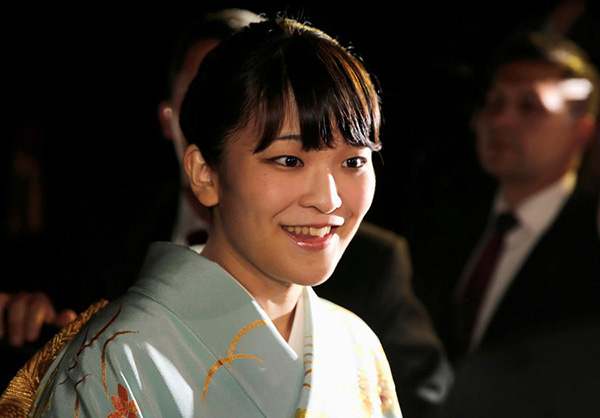 |
| Japan's Princess Mako arrives before a meeting with Paraguay's President Horacio Cartes at the presidential residence in Asuncion, Paraguay September 8, 2016. [Photo/Agencies] |
Under Japan's Imperial Household Law, which governs the succession of emperors, women born into the imperial family must officially leave it once they marry commoners. Mako's aunt, Sayako, the only daughter of Emperor Akihito, renounced her imperial title for love, tying the knot in 2005 with a town planner.
Mako's love story has melted the hearts of her peers and drawn praise from the Japanese people. But Emperor Akihito's is the more touchy story.
In a rare televised address in August 2016, the octogenarian emperor informed the nation of his desire to abdicate the throne due to failing health. But the Imperial Household Law, which has no provision for abdication, only allows posthumous succession.
Opinion polls have shown the vast majority of Japanese people sympathize with the emperor and respect his desire to retire, and the Japanese government and parliament have approved one-off legislation for his abdication. Eventually, a special panel will decide the dates for Emperor Akihito's abdication and the enthronement of his elder son, Crown Prince Naruhito.
Emperor Akihito would be the first living Japanese emperor to abdicate in 200 years. The emperor is a symbol of Japanese unity, but without any political power. His duties include constitutionally defined tasks such as the opening of parliament. The hallmark of the emperor's reign has been travels with Empress Michiko, including visits to domestic disaster sites to cheer the survivors, and trips to foreign countries to soothe the wounds of Japan's aggression before and during World War II.
The imperial couple visited Beijing, Xi'an and Shanghai in 1992. "I felt that most of the Chinese people hope for friendly relations between our two peoples," Emperor Akihito said in Shanghai on the eve of his departure for Tokyo. "If people deal sincerely with each other heart to heart, I believe borders can be bridged."
Now that Emperor Akihito is set to abdicate, the Japanese government and business organizations have tons of work to do to prepare for a new era. Despite using the Gregorian calendar in most aspects of everyday life, Japan has maintained its ancient imperial-era system in which a new emperor ushers in a new era that the Japanese Cabinet defines in two auspicious Chinese characters.
The current era is Heisei, which began in 1989 when Emperor Akihito succeeded to the throne upon the death of his father Hirohito. This is the 29th year of Emperor Akihito's reign, or Heisei 29. Heisei literally means "achieving peace".
Many institutions, such as banks, city halls and driving schools, are not interested in your date of birth according to the Gregorian calendar; they need you to put your date of birth according to the imperial calendar on their forms. Of course, their employees are ready to help if you have difficulty in figuring out what year of the Japanese imperial era you were born in.
The Japanese government is expected to announce the name of the new era months before Emperor Akihito abdicates, allowing time for the switch to be made in official forms, calendars and computer programs. The government is considering April 30, 2019, as the most suitable date for the emperor to abdicate, the Japanese media reported, and Prince Naruhito to be enthroned the following day.
Though a change in the imperial era causes some inconvenience to the Japanese people, it also helps them to cherish their history and tradition. A country is known for its economic prowess as much as its culture.
The author is China Daily Tokyo bureau chief. caihong@chinadaily.com.cn





