



Mall owner: Physical retail can thrive, despite e-commerce, with innovation









Although brick-and-mortar retailers have felt the impact of robust online buying in recent years, the in-store shopping experience remains dominant in the retail sector, and online and offline retailing can coexist and cooperate, according to the managing director of HKR International Ltd.
"E-commerce indeed has made its strong impact towards physical retail, but brick-and-mortar stores are irreplaceable and continuing taking the lion's share of retail sector," said Victor Cha, who also serves as deputy chairman of HKR International.
According to data issued by the Ministry of Commerce, China's online retail sales of physical goods totaled 4.19 trillion yuan ($633.5 billion) in 2016, up 25.6 percent year-on-year but still accounting for only 12.6 percent of the retail value of all consumer goods purchased.
Similarly, financial research firm Gordon Haskett said in a recent survey that apart from music, books, movies and small appliances, consumers showed a preference for in-store purchases, especially for experienced-based categories such as groceries, household, health and beauty, pets and automotive products.
"Shopping malls are no longer a place purely for shopping, but a one-stop experience provider for shopping, lifestyle and social ... Retailers have to either embrace this trend peacefully or be phased out," Cha said.
Cha told China Daily that its newly opened, 322,000-square-meter commercial complex HKRI Taikoo Hui aims to draw consumers with bespoke design and quality.
Officially opened in early November on Shanghai's bustling West Nanjing Road, the development, with an investment of up to 18 billion yuan, features a shopping mall, two hotels, one serviced apartment building and two office buildings. HKRI expects the project to generate revenue equivalent to two-thirds of 11 total projects of similar size in 2018.
According to Cha, the projection is based on innovative retail brands attracted by the shopping mall, the interaction made between online and offline, as well as the application of big data to analyze the preferences and habits of their target customers.
In order to stand out from the high homogeneity of shopping malls' brands, HKRI Taikoo Hui mall did not introduce top luxury brands such as Louis Vuitton or Gucci.
Among the approximately 250 diversified brands in the mall, eight had their China debut stores, 22 were opening their first outlet in Shanghai, and 15 are special concept stores, Cha said.
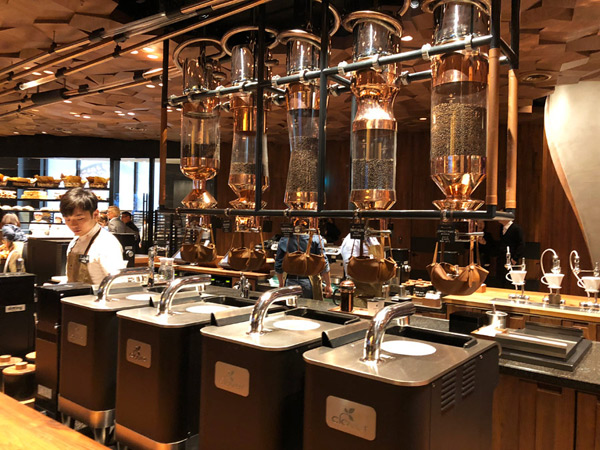
The HKRI Taikoo Hui is also the location of the newly opened Starbucks Reserve Roastery in China, the only such Starbucks of its kind except for Seattle, also home to the company's headquarters.
"On average, more than 70 percent of the brands in Shanghai's departments stores and shopping malls are the same, so what brands the developer chooses will decide how successful it is," said Qi Xiaozhai, head of the Shanghai Society of Commercial Economy.
When more internet retailers such as Alibaba and JD go offline and open physical stores with their advantages in capital and big data resources, traditional retail operators should adopt state-of-the-art technologies to become competitive, according to Cha.
In the past 15 years, HKR International has made a total investment of about 20 billion yuan into the Chinese mainland, accounting for nearly half of the company's total investment during the period.
"Our weighing in the Chinese mainland, especially in the Yangtze River Delta region, will continue to grow, as we are a Chinese company, and we will continuously look for real estate investment opportunities both in residential and commercial sectors, in line with the central government's policies and strategies," Cha said.
"The Chinese people in the past two decades have generated abundant wealth; in regards to their strong attachment in buying property, high-quality residential property will continue to be sought after by the expanding middle class, and that is what we were doing for the past four decades and will continue to do in the coming four decades."
















