Quantum scientist among Nature's 'people who mattered' in 2017









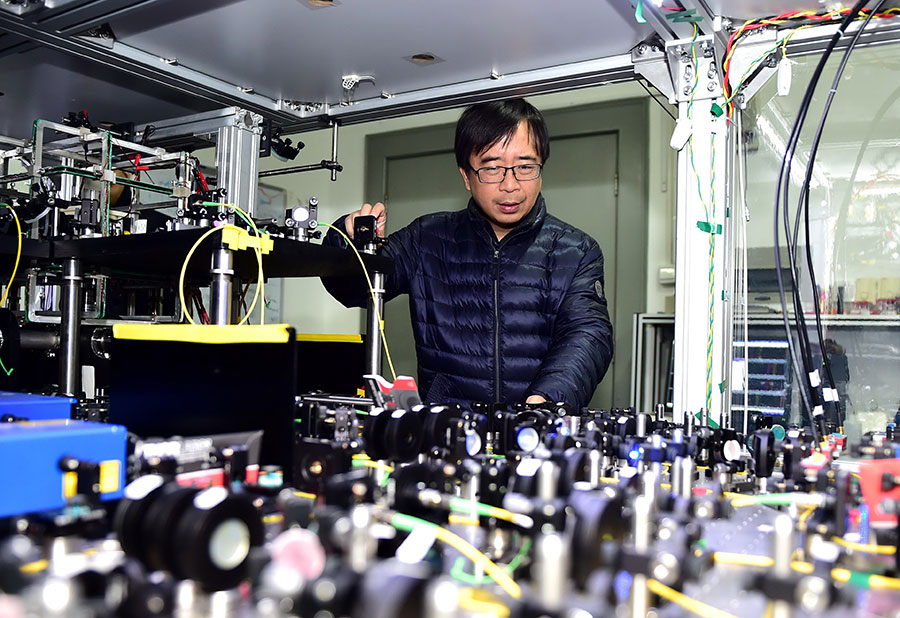
Pan Jianwei, a leading quantum scientist in China, has been recognized by Nature magazine on its list of 10 "people who mattered" in 2017.
Nature published the list on Tuesday, saying the nickname "father of quantum" is an apt moniker for Pan, who "has been widely hailed for leading China to the forefront of long-distance quantum communication, harnessing quantum laws to transmit information securely".
Pan, from the University of Science and Technology of China, is chief scientist of the world's first quantum satellite project.
The Mozi satellite was launched in August last year. Thanks to Pan's years of work, China became the first country in the world to transmit the quantum state of a photon on Earth 1,400 kilometers to a photon on an orbiting satellite, paving the way for ultrasecure, long-distance quantum communication.
"We hope to build a network of satellites and ground-based equipment that can share quantum information across the globe and ultimately build a quantum internet," Pan, 47, said during a speech at a forum in Shanghai on Monday.
In September, his team used the satellite to beam photons to Beijing and Vienna, Austria, generating quantum encryption keys that allowed teams in the cities-7,800 km apart-to video-chat with complete security.
Detecting the photons disturbs their quantum states, which means that no hacker can intercept the keys without being noticed.
Nature quotes Anton Zeilinger, Pan's former PhD adviser and current collaborator at the University of Vienna, saying that the demonstration was a "historic event".
After studying at the University of Science and Technology of China from 1985 to 1995 for his bachelor's and master's degrees, Pan went to Vienna in 1996 for doctoral studies and employment and stayed there until 2001, when he returned to the Chinese university as a physics professor. He then began to build a quantum science research team at the university.
The team now includes about 50 scientists, most of whom are also returnees from overseas and younger than Pan.
He became the youngest member of the Chinese Academy of Sciences, the country's top scientific body, in 2011 and was named the standing vice-president of the University of Science and Technology of China in 2015.
Zhou Wenting contributed to this story.


- Xizang's remote villages gain access to express delivery services
- Egyptian man explores 460-year-old fair in Tianjin
- 10,000-ton electric container ship tests off Jiangxi province
- China's construction sector sees drop in energy use, emissions during build phase, rise in operations
- Guangdong sees surge in holiday arrivals as travel pattern shifts
- International commercial court established in Guangzhou