



Financial institutions of banks may get bond approval









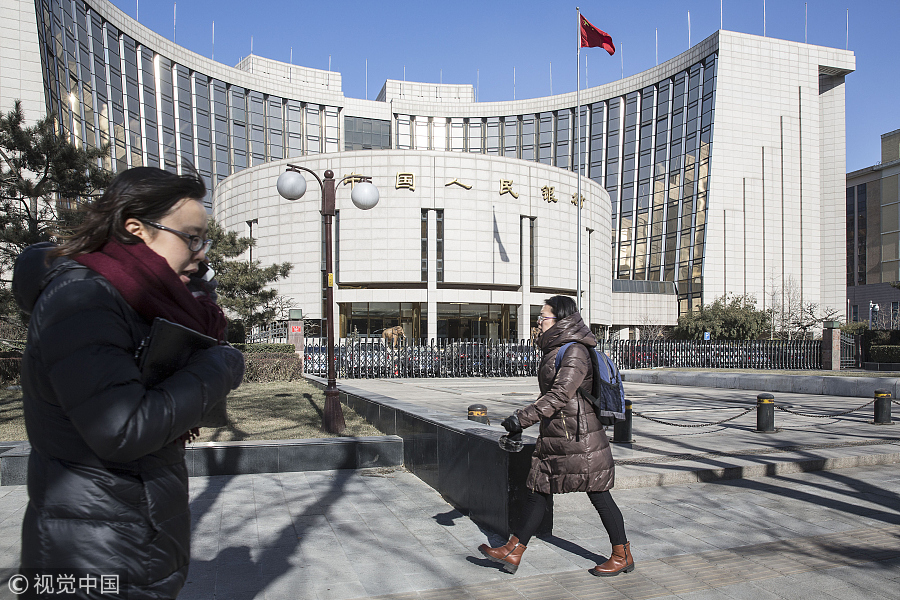
The People's Bank of China, the central bank, will encourage financial institutions belonging to the banking sector to issue creative and new types of bonds to supplement capital ahead of the tighter international regulatory standards that will come into effect from Jan 1, 2019.
An announcement published on the PBOC website said that "financial institutions belonging to the banking sector can explore and issue bonds to enhance their total loss-absorbing capacity (TLAC)."
The TLAC standard was designed and approved by the Financial Stability Board-an international body that monitors and makes recommendations about the global financial system, in 2015, for global systemically important banks (G-SIBs), to ensure they have sufficient loss-absorbing and recapitalization capacity if they fail. It aims to minimize impact on financial stability and avoid exposure of public funds to losses.
Required by the new standard, the minimum requirement for the instruments and liabilities that should be readily available for bailin within resolution at G-SIBs should be at least 16 percent of their risk-weighted assets as of Jan 1, 2019.
The central bank's announcement also clarified that "when it comes to resolution, the capital supplement bonds can be written down or swapped into equities".
It means the country could soon issue a new type of bond designed with specific conditions when it needs to be swapped into equity as the bail-in procedure starts, or the special type of the so-called tier-two capital supplement bond, according to Lu Zhengwei, an economist with the Industrial Bank.
It is also possible to create a type of bond without fixed maturity in the future, he said.
As China's financial regulation has been further tightened during the past year, especially to limit the less-transparent and high risky shadow banking activities, commercial banks are facing increased pressure on capital management-which is usually one of the central approaches to prevent risks.
Chinese banks, especially the listed ones, are actively exploring alternative financing channels to improve their capital management capabilities and promote the efficient use of capital.
According to data from China Banking Regulatory Commission, by the end of 2017, Chinese commercial banks' capital adequacy ratio averaged 13.65 percent, up 0.37 percentage points since 2016.
Sun Haibo, president of the Shanghai Faxun Financial Information Service, said that as the off-balance sheet lending may require to be recorded back onto commercial bank's balance sheet in the future, the central bank's move is to lead them onto a "new path" to meet the regulatory standard and prevent systemic financial risks.
As of today, four Chinese banks are identified as G-SIBs: the Industrial and Commercial Bank of China, China Construction Bank, Agricultural Bank of China and Bank of China.




















