



Automakers warn United States tariffs to hit sector hard









The auto industry is warning that US sales declines, which have been consistent over the past year, may continue thanks to tariffs US President Donald Trump plans to slap on steel and aluminum imports.
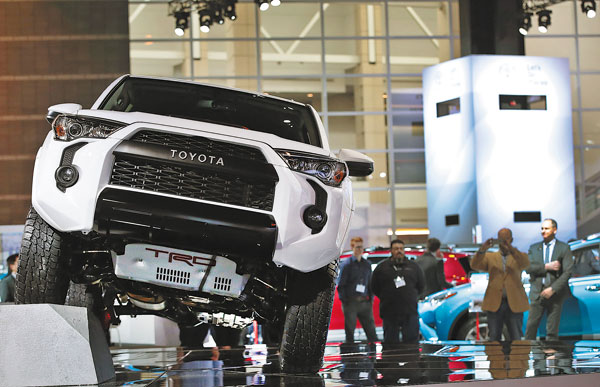
Toyota Motor, which plans to build a new $1.6 billion factory in Alabama with Mazda Motor, said the administration's decision will "adversely impact" auto companies by raising costs and prices of cars and trucks sold in the US.
That's even as more than 90 percent of the steel that Asia's biggest carmaker uses in the US is from that country.
Trade groups representing automakers including General Motors Co and Toyota, plus parts suppliers like Robert Bosch GmbH, tried to warn the Trump administration of unintended consequences. That's before the president said Thursday he plans to order tariffs of 25 percent on imported steel and 10 percent on aluminum.
Asian automakers' shares declined in response to the announcement while US carmakers-already slipping because of weak February sales-extended their falls.
"These proposed tariffs on steel and aluminum imports couldn't come at a worse time," said Cody Lusk, president of the American International Automobile Dealers Association.
"Auto sales have flattened in recent months, and manufacturers are not prepared to absorb a sharp increase in costs to build cars and trucks in America."
Honda Motor Co, which declined to comment on the administration's move, led the drop in shares of Asian carmakers.
Five of the six biggest car manufacturers on Thursday posted lower February US deliveries than a year ago. General Motor shares slumped 4 percent in New York, while Ford Motor dropped 3 percent and Fiat Chrysler fell 2.8 percent.
The average car includes about $830 of steel and $400 of aluminum, according to a Feb 26 analysis by Colin Langan, an analyst with UBS.
He projected that Ford's raw materials costs were already going to rise by $1 billion this year, and said Thursday that the tariffs would add another $300 million.
GM's raw materials costs, already seen climbing $800 million, are projected to rise an additional $200 million from the import measures.
Langan characterized the rising raw material costs as being "manageable."
Charlie Chesbrough, senior economist for researcher Cox Automotive, estimated the tariffs Trump proposed would add about $200 to the total price of a vehicle.
"It's unfortunate, because it comes at a time when there are already fears about inflation," he said in an interview. "This is only going to add fuel to that fire."
Toyota said it buys sheet steel from United Steel Steel, Arcelor-Mittal and AK Steel Holding, and sheet aluminum from Arconic, Novelis and a venture of Constellium and UACJ.
Carmakers and suppliers getting most of their aluminum and steel from US producers may not shield them from rising costs, said Kristin Dziczek, director of the industry, labor and economics group at the Center for Automotive Research in Ann Arbor, Michigan.
That's because those producers also use imported materials, which they process into other steel or aluminum products, she said.
While the Trump administration did the auto industry a favor by cutting taxes late last year, the tariffs have the potential to nullify many of the benefits by boosting vehicle prices, said John Bozzella, president of the Association of Global Automakers.
The group represents companies including Japan's Toyota, German group Bosch and South Korea's Hyundai Motor.
"Investments earmarked for new products and plants will instead be funneled to pay for rising steel and aluminum prices used in existing products and facilities," Bozzella said in a statement released Wednesday.
Global automakers said that former president George W. Bush's 2002 steel tariffs cost the economy 200,000 jobs, including 30,000 in Michigan, Ohio and Pennsylvania.
Even without the new tariffs, rising metal prices have been a problem for Ford.
The second-largest US automaker said in January that 2018 would be a "bad year" as costs surged. The price of steel, Ford's biggest commodity purchase, has jumped about 33 percent since the start of last year. Aluminum, used for the bodies of F-Series pickups, is up more than a quarter.
"Certainly, this is going to be a negative for the vehicle market," Chesbrough said.
"At some point, it's going to put vehicles just out of reach for some buyers and it's going to cause some kind of pullback in the market."
Bloomberg


















