Japanese firms' scandals offer a vital lesson









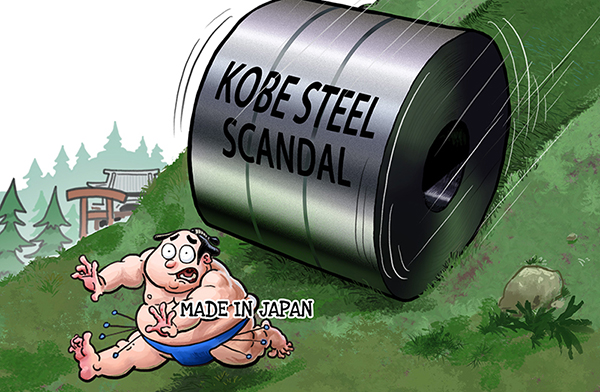
The shockwaves from the malfeasance in some of Japan's big companies continue to be felt as new revelations emerge. On Tuesday, Kobe Steel CEO Hiroya Kawasaki said he would step down, taking responsibility for the quality control lapses that resulted in substandard materials being supplied to about 605 clients, including 222 overseas companies.
Kobe Steel, which is Japan's third-largest steelmaker, sells its products to all kinds of businesses, including those in the aviation and automobile industries, railways and nuclear power plants.
US consumers have filed a lawsuit against Kobe Steel and Toyota Motor Corp accusing the two Japanese companies of violating consumer protection laws and indulging in fraud by concealing the use of substandard metal components in the latter's vehicles. The complaint claims that Toyota models, such as Prius, Camry, Land Cruiser and Lexus, have all been made using substandard steel, aluminum and copper.
As well as Kobe and Toyota, revelations of defective products, data tampering and inappropriate quality control procedures have plagued other Japanese companies such as Takata Corp, Mitsubishi Materials Corp, Toray Industries Inc, Nissan Motor Co and Subaru Corp.
The US National Highway Traffic Safety Administration has said that an estimated 37 million vehicles are currently under recalls due to defective Takata air bags that can explode when automatically inflated, causing serious injury or even death to passengers. Exploding Takata air bags have been linked to at least 23 deaths worldwide.
The United States is scheduled to recall more air bags by December 2019, increasing the total number of affected air bags from 50 million at present to 65-70 million, the largest recall in US history.
The Japanese companies concerned say the root cause of their wrongdoings is intense pressure-to cut costs, meet deadlines and increase profits.
Japan's manufacturing sector faces major challenges such as a labor shortage due to the country's rapidly aging population, high labor costs, and the high costs of materials due to a lack of natural resources.
Experts on industrial logistics say that, since the manufacturing sector across the world has become more technologically advanced, it is more likely that a single supplier, or even a single factory, can be critical to a whole industry. Japanese corporations have monopolies or oligopolies in a host of crucial niches, such as the supply of advanced materials, components and production machinery for industries, including electronics, cars and aviation.
As the latest revelations show, the domination of one supplier could also be risky for global supply chains. The earthquake that rocked Japan's industrial base of Tohoku on March 11, 2011, triggered temporary shortages of some Japanese components in many global companies, including Ford Motor Co and General Motors Corp.
Although advanced economies still dominate the upstream tasks of the global value chain and emerging economies continue playing their roles downstream, participation in global supply chains is becoming increasingly dynamic. Emerging economies, including China and Mexico, are beginning to climb upstream in the global production chain as they contribute more value-added in intermediates.
Despite the quality crisis that has rocked its manufacturing sector, Japan's manufacturing growth hit a four-year high in January and shipments increased for a 13th straight month in December. The full picture of the scandals is still emerging, though. Some of the Kobe's data falsifications date back five decades, when companies in developing countries could hardly compete with Japanese corporations.
However, the problems in Japan's manufacturing sector, can serve as a lesson for China which has vowed to build itself into a manufacturing powerhouse.
The author is China Daily Tokyo bureau chief. caihong@chinadaily.com.cn