



Historic move to streamline departments









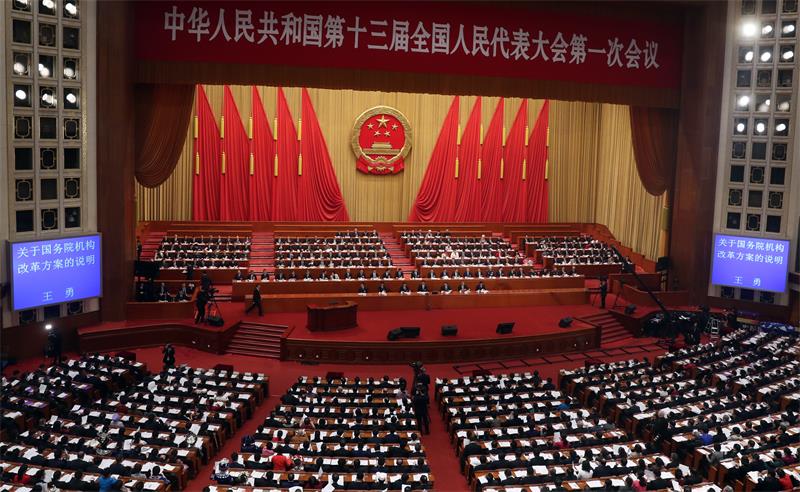
Editor’s note: The deepening of Party and State institutions’ reform is a big move initiated at the Third Plenary session of the 19th Communist Party of China Central Committee. Six scholars share their views with China Daily on the State Council’s proposal to reshuffle the institutions. Excerpts follow:
Reform responds to call of the new era

The reform of Party and State institutions aims to promote the modernization of the country’s governance system, as required by the third plenum of the 18th CPC Central Committee and the 19th National Congress of the CPC. The Party’s and country’s institutional reform will accordingly fulfill the requirements of modernizing governance capacity so as to meet the conditions of the two stages for the country’s modernization, that is, to basically achieve socialist modernization by 2035 and become a strong modern socialist country by 2050.
This is the eighth institutional reform since the first one in 1982 in response to the call of the new era. The reform will incorporate part of the Ministry of Land and Resources into the proposed Ministry of Ecological Environment, which will be set up to meet the demands of green development and to better prevent and control pollution. It will also make overall governance, from the perspective of resources, and the environment and ecology, more efficient than the existing system of separated governance.
Compared with the last State institutional reform in 2013, the reform of Party and State institutions this time will be comprehensive in nature and better meet the development demands in the new era. For instance, the Ministry of Supervision and National Bureau of Corruption Prevention will be incorporated into the new National Supervisory Commission, which is a significant reform to merge administrative departments into national bodies.
This round of reform of Party and State institutions, among other things, is aimed at enabling the market to play a decisive role in resource allocation, and improving governance.
The reform’s aim is also to avoid the overlapping of different departments’ functions and improve their efficiency, as some administrative reforms in the past made some institutions more complicated and overstaffed despite the original intention of streamlining them. The key to solve this problem is to transform government functions, in which the government delegates power to the market, society and lower authorities in the areas that they can better fulfill their duties.
Ding Yuanzhu, a professor at the Chinese Academy of Governance. This is an excerpt from his interview with China Daily’s Wang Yiqing.





