



'Seawater rice' may help fill food gap









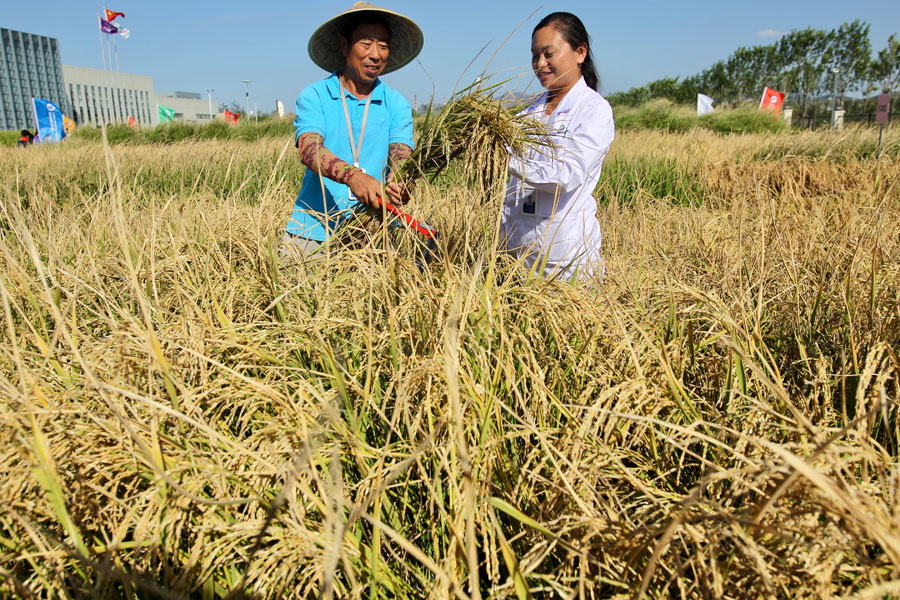
Chinese agricultural researchers have selected 176 strains of saltwater-tolerant rice out of more than 1,000 candidates from experimental paddies and expect them to be widely planted across the country in further trials this year.
Experts said this marks a major step forward in the development of resistant rice strains in China.
Rice that can thrive in a saline-alkali environment-so-called seawater rice-is designed to grow in tidal flats or other areas with heavy saline-alkaline content.
The selected strains, grown in Hainan province paddies, will be planted on five different types of saline-alkali land around the country. Researchers aim to find at least one type with nationwide applicability for future use, said Zhang Guodong, executive director of the Qingdao Saline-Alkali Tolerant Rice Research and Development Center in Shandong province.
The center, led by Yuan Longping-China's "father of hybrid rice"-was founded in 2016 to help expand the farming of resistant rice around the country.
"China has a great deal of saline-alkaline soil, but these areas are located in various climatic zones with different sunlight conditions," said Zhang, the center's director, adding that researchers will test the quantity and quality of the selected strains under different climatic and geological conditions.
Previous studies found that about 13 to 20 million hectares of saline-alkali soil can support rice-mainly in five areas, including the Xinjiang Uygur autonomous region, North China and along the mouth of the Yellow River. The Qingdao center has experimental paddies in these areas.
The center uses desalinated seawater to irrigate its experimental paddies, with the highest yield reaching 9.3 metric tons per hectare in 2017.
In addition to working with the 176 selected strains, researchers in Hainan are also making efforts to use hybrid technologies and genetic engineering to breed more strains of saline-alkali-resistant rice for further trials.
"Saline-alkali-resistant rice in China is still in the scientific research and observation stage before full application," Zhang said.
Since 1970, the International Rice Research Institute has verified 10 tolerant strains out of 9,000 strains of the grain, providing a technical basis for breeding tolerant varieties. The institute put forward its verification standards for saline-alkali-tolerant rice in 1979.
Countries including Pakistan, Japan, the United States, the United Kingdom and Australia are also carrying out rice research.
Yuan and his team plan to develop a type of seawater rice that can be planted on 6.7 million hectares of saline-alkali land around China, which they estimate can yield 30 billion kilograms every year, feeding 80 million additional mouths.
Yuan said growing more seawater rice is vital to China's food security.
- Digital era helps old foodmaker in delivery, expansion
- The Daily Telegraph Publishes a Signed Article by Abassador Liu Xiaoming Entitled Through Open Cooperation, We Can Protect Intellectual Property Rights
- Scientists bring fields in Hainan back to life
- Policies released to boost China's agricultural growth


- CNS Sichuan sets sail for trials in South China Sea
- Exhibition of natural resources science and technology achievements to kick off
- China promotes cooperation in nuclear technology use
- Five new colors enhance rapeseed flower appeal
- US student finds connection to China through classical poetry
- Tongzhou launches legal service mini-program to aid enterprises in global IP challenges





