Attack on Confucius Institutes motivated









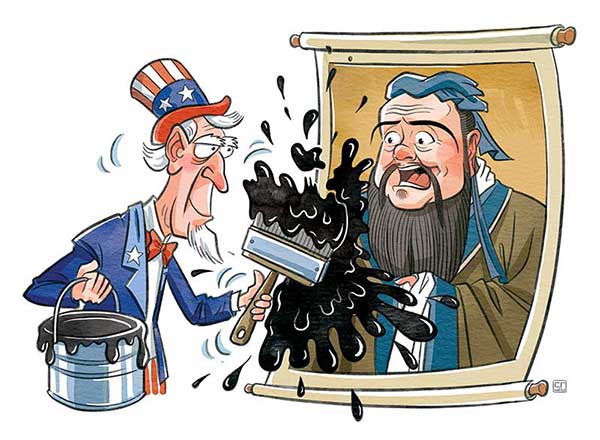
Editor's note: Recently several US senators including Marco Rubio, Tom Cotton and Joe Wilson have appealed to the US Congress to list Confucius Institutes as "foreign agents" according to the Foreign Agents Registration Act. Two experts share their views on the issue with China Daily's Liu Jianna. Excerpts follow:
Hardliners have hijacked the US' trade policies
Li Haidong, a professor at China Foreign Affairs University
The latest assault on Confucius Institutes in the United States is part of concerted efforts to limit the engagement and exchanges with China by forces hostile to China. Even the US-China Economic and Security Review Commission affiliated to the US Congress, in its annual report issued in November, has demanded that Chinese media outlets in the US be listed as "foreign agents".
The Foreign Agents Registration Act was enacted in 1938 to restrict political propaganda by Nazi Germany. According to the US Department of Justice, the act requires people acting as agents of foreign powers in a political or quasi-political capacity to disclose their relationship with the foreign government, and their related activities, including receipts and disbursements of funds. However, the wanton or dubious use of FARA will create serious problems for even normal cultural and civil exchanges between China and the US.
This raises the question: Why some US politicians are targeting cultural programs and exchanges organized by China? The fact is, what we see today is the inevitable development of the debate on China's policies in the US from 2014 to 2016, which gave US hardliners the upper hand in bilateral relations. The debate also revealed the Trump administration is reducing its engagement and increasing its efforts to contain China.
New fronts have opened up in the "anti-China war" thanks to the efforts of the hardliners. Given these facts, the targeting of Chinese cultural and exchange programs by certain US politicians is not hard to explain. Policies unfavorable to China and Sino-US relations are being introduced because there are no political elements to effectively counter the hardliners' assault on China. This shows the tide has turned in Sino-US relations and US President Donald Trump is only following the trend, which incidentally he also helped start.
Despite the US' confrontational moves, however, China can still take some measures to ease tensions on this front. For instance, it can encourage nongovernmental exchanges to clear the US' doubts over government-funded programs. But more dexterity and agility should be applied when dealing with Sino-US ties in these gloomy times.