


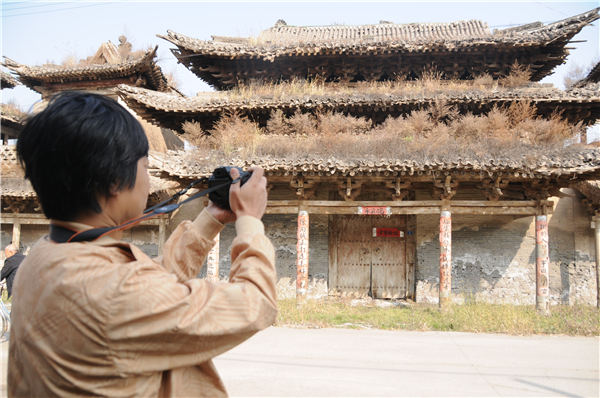
The dilapidated buildings in the villages of North China's Shanxi province appear to have no future. But to Tang Dahua, 48, they are "dying friends", and he wants to save them.
His photos tell their stories: an old temple is now a sheepfold hemmed in by piles of dung; an ancestral hall is overrun with weeds; a centuries-old wooden pagoda rots away; a collapsed theater has only three walls standing; frescoes in a damaged temple are heavily eroded.
Some are listed as cultural relics at the county level, but some are unknown even to locals.
Tang posted the photos on social media, arguing the buildings are cultural relics that are worthy of preservation before "they perish in the wild".
"In front of these buildings, you feel the smallness of humanity and the cruelty of time. You think something should be done," says Tang.
Tang has been taking pictures since 2006. He usually spends half a year seeking, researching and photographing pagodas, temples and other old sites in Shanxi, which is home to 452 relic sites under State-level protection and more than 28,000 ancient architectural sites-among the most in all of China's provincial regions.
He has crossed hills and rivers, and braved freezing cold and extreme heat, driving hundreds of kilometers from his home in Shandong province.
He has visited and photographed more than 400 long-neglected sites. And his Weibo social network project, Snapshots of Historical Sites, features more than 200 ancient buildings on the verge of collapse.
Tang says most of the information he gets is provided by travelers, cyclists and villagers.
"They have one thing in common-they love history."
An internet entrepreneur, Tang started the project in 2011, after he posted a series of photos of a wooden temple built more than 110 years ago.
"The dilapidated site shocked people," recalls Tang, who saw his photos to draw tens of thousands of hits and reposts in a day.
The project brought him 350,000 followers and he hopes that more relics can be survived with public attention.
A notable success was a decaying temple Longtian, which he found in 2014 in Xilianghe village, 16 kilometers from Pingyao county, a UNESCO world heritage site since 1997.





