



AI seen as driving force in Industry 4.0









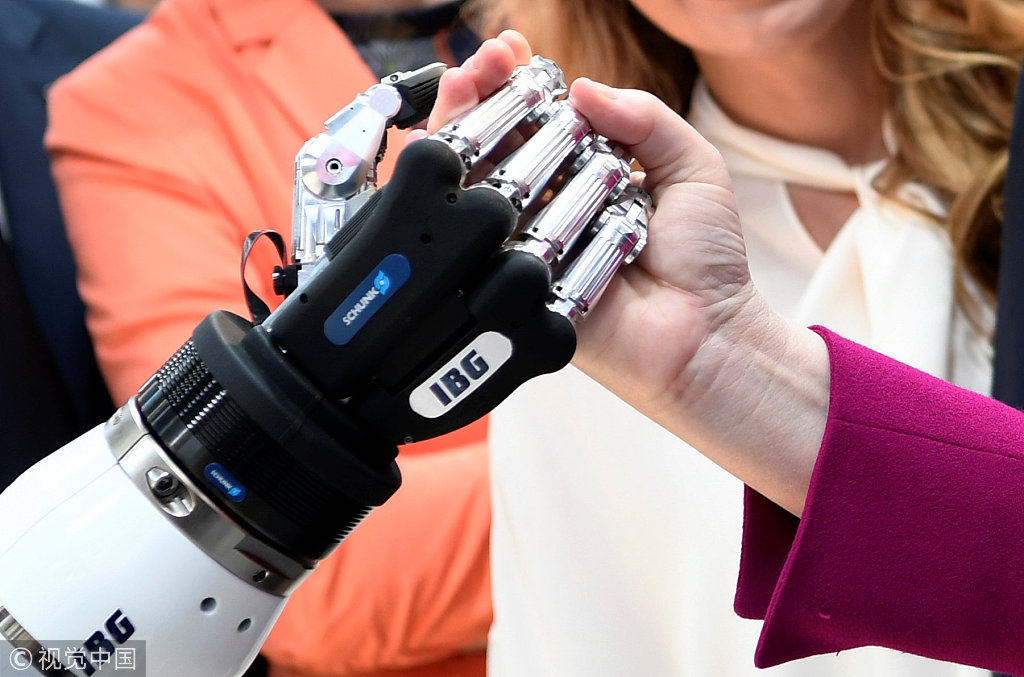
HANOVER, Germany - Artificial Intelligence (AI) is no longer a vision for the future, as the technology has already been introduced to consumers in the form of virtual assistants in our smart phones, tablets, speakers and computers. But how does it fit into the Industry 4.0 concept?
During the ongoing Hanover Fair 2018, information technology (IT) companies and robotic equipment producers are keen to paint a picture of future factories where AI plays a key role in it.
Two branches of artificial intelligence - machine learning and deep learning - are seen as having the capability of building on the strength of big data to optimize processes, find new solutions, and gain new insights.
Especially for machine learning, it enables predictions to be made based on large amounts of data. This branch of artificial intelligence is built upon pattern recognition and has the ability to independently draw knowledge from experience. For this reason, the technology has found its place in industrial processes.
"Because AI enables to connect two machines. If I get the information from a machine then I am able to start to predict an outcome, I can start to predict maintenance, I can start to predict the quality of product, I can start even to predict logistics processes," Hans Thalbauer told Xinhua.
Thalbauer is the senior vice president in charge of Internet of Things and Digital Supply Chain at SAP, a German-based multinational software corporation.
"It is really going away from the reactive, alert-driven type of business," said Thalbauer.
At SAP's booth, the company showcased a bottling machine that can fill different bottles with different colored liquid instead of just one, which SAP developed with other equipment producers.
This is quite different from the conventional manufacturing process, which can only produce a certain type of product one at a time. The sensors on the machine collect and send the data to the computing platform, which can then analyze the process and tell the machines how to handle the individual bottles.
Nowadays, every single product on the production line can be individualized, and the cost can be at a level similar to mass production, said Thalbauer.
Another interesting approach from SAP is smart, automated assembly work stations. They understand which order has priority, if the required resources are available, how long the battery will last, and much more. Using this knowledge, they can independently decide whether it is more efficient to skip an assembly step first and then perform it later. This means assembly lines are no longer linear but flexible. This could mark the beginning of the end for the assembly line.
From small and medium-sized companies to large international corporations, every organization can accumulate data that it can make use of. With software, this data is consolidated and evaluated to make predictions. Machine learning recognizes characteristics and relationships and uses algorithms to make generalizations from them.
However, AI's benefit is yet to be fully recognized by companies in various sectors.
Artificial intelligence is supposed to keep Europe's energy suppliers competitive, but only 23 percent have an AI implementation strategy, according to a study by Roland Berger, a consulting firm headquartered in Munich.
Some 83 percent of the more than 50 interviewed companies in the sector realize that something has to change, and they assume that AI will play an important role in their future business. At the same time, 40 percent acknowledge that they have no use concept for the technology, the study shows.
The consultants recommend a gradual introduction - utility companies should first use prepared applications to optimize existing systems - and the funds saved could then be used by companies to develop new AI business models.




















