


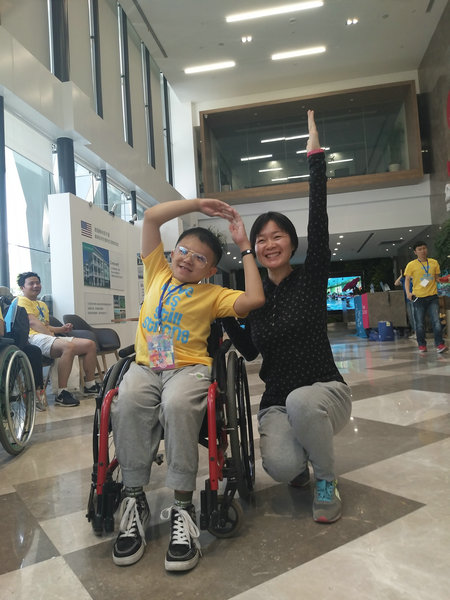
Complicated disease
"But OI is a relatively complicated disease, and it takes the cooperation of many departments-from orthopedics, internal medicine and rehabilitation to anesthesiology and otology-depending on the patient's particular case," explains Sun.
In recent years, the center has been working together with a number of hospitals and medical teams, many of them doctors who have been trained overseas, to provide timely and specialized treatment to OI patients around China.
Several times a year, the center assembles a team of experts from a number of different medical organizations and clinical branches to visit cities all over China to provide training to local doctors about the diagnosis and treatment of OI. It also works with medical organizations to provide free and specific treatment to around 40 local OI patients, as well as arranging follow-up checks.
Other efforts include closely observing international medical progress in controlling the disorder, and sharing it with doctors in China and the families of patients.
Their efforts have yielded positive results.
"Not only do more hospitals provide specialized treatment for OI, but more clinical departments are involved today," Sun says.
The center also provides government with data and research results jointly carried out with a number of universities, to advocate supporting policies on issues like helping children with the disease receive a proper education.
"Our hope is to help OI patients better integrate into society and live their lives with dignity," says Sun, adding that they try to establish a positive and objective image of the special group.
"We can only push forward medical treatment, social benefits, social integration and other aspects concerning OI patients when the public has a better understanding of this disease and this community," says Sun.
Research by the center has found that the majority of osteogenesis imperfecta sufferers in China still face huge challenges.
The rates of inappropriate diagnoses and treatment still remain high, and many patients, especially those in remote areas, rarely receive proper treatment due to financial difficulties-leading to persistently high rates of disability among sufferers. At the same time, knowledge about the disease remains limited among certain groups of doctors.
Zhang discovered the center while searching the internet and immediately sought their help.
"I was thrilled. Finally there were people who understood my situation and were able to talk to me about it," says Zhang, who now works as an intern at the center.
"I joined the team because I wanted to help people who have the same problem as me by sharing my own experiences and knowledge."
Contact the writer at liuxiangrui@chinadaily.com.cn





