


It's common these days to see Chinese and Western musicians work to create musical pieces that combine elements from both genres.
And while this type of musical collaboration was rare in the 17th century, it was not unheard of.
Yet, thanks to the efforts of Diego de Pantoja, a Spanish missionary who had been in China since the end of the 16th century and established cultural relations with the court of the Emperor Wanli (1563-1620) during the Ming Dynasty (1368-1644), the practice was pioneered.
Pantoja brought with him the first foreign instrument with a keyboard to the Forbidden City and demonstrated to the court the musical art of playing the clavichord.
It was from this time on that Western instruments such as the clavichord, spinet, organ and harpsichord began to appear in the Chinese imperial court.
And as a tribute to Pantoja, a program of music composed during the 16th to 18th centuries was staged in Beijing recently.
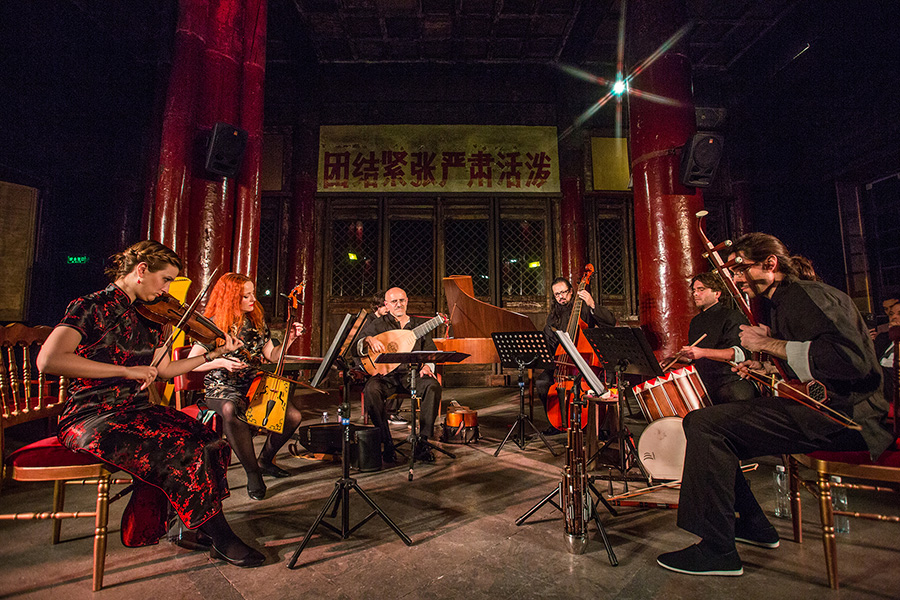
The concert took place in a traditional Chinese wood-and-brick building in the style of a temple, located in a bustling hutong in the city's Dongcheng district.
With its red pillars lining the interior, the building dates back to the Ming Dynasty and was once the site of an imperial printing workshop.
Seven Spanish musicians, with the women dressed in qipao and men in Chinese suits, played a program that blended the Western baroque style with traditional Chinese music.
The music was once played to the Chinese imperial court in the Forbidden City during the Ming and Qing (1644-1912) dynasties.
The musicians played Western orchestral instruments including the violin, harp and violone, alongside typical baroque instruments such as the lute and harpsichord-as well as the Chinese instruments, the erhu, dizi, sheng and guzheng.
The instruments mixed harmoniously and, in some pieces, the melody was accompanied by an aria, which was combined with the singing styles of traditional Chinese Kunqu Opera.
The musicians were from two separate bands. One is called Todos los Tonos y Ayres, which specializes in the research and interpretation of early Chinese music, as well as the musical relationship between Imperial China and the West.





