



Media must better project China's image abroad









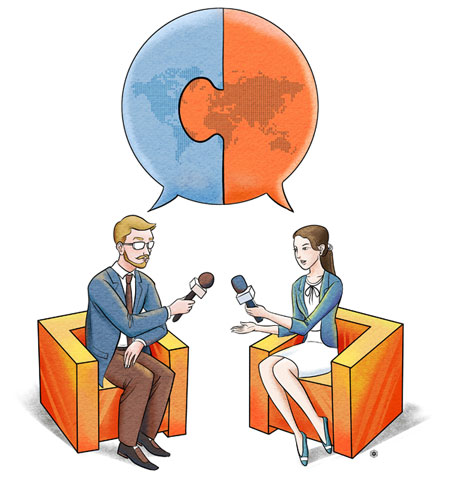
China is playing a pivotal role in reforming the world order. It is already the world's largest trader of goods and the second-largest economy and, if its growth momentum continues, it will overtake the United States in the foreseeable future to become the largest economy.
For the wider world, China has been providing public goods, including through channels such as the Belt and Road Initiative and the Asian Infrastructure Investment Bank. And its vision of building a community with a shared future for mankind has won recognition across the world. There is little doubt, as such, that China is taking initiatives to influence the rules of the game that were mostly set by the West.
Within China, socialism with Chinese characteristics has entered a new era, and the Communist Party of China with over 89 million members has made unswerving efforts to maintain its purity and grow stronger. Under the leadership of the Party with Xi Jinping as its core, nearly 90 million people have been lifted out of poverty since 2012. And given that the strictest environmental protection system has been put in place, there is a social consensus that the environment should be cherished and protected. Besides, innovation, technology and consumption have replaced investment and trade to become the main drivers for economic growth.
The challenge now for China is to make the international community understand the importance of these changes in order to deepen mutual trust and avoid strategic misinterpretations, so that more countries can benefit from its fast-paced development.
The rise of social media and the reform and streamlining of the Chinese media-for instance, the establishment of China Global Television Network in late 2016, and the merger of China Central Television, China Radio International and China National Radio to form the Voice of China earlier this year-h(huán)ave provided China with more efficient platforms and channels to tell its stories.
As a result, people in other countries now have better accesses to information about China, and more foreign reporters and editors have been employed to tell China's stories around the world.
Since becoming China's top leader, President Xi Jinping has attached great importance to the cause of international communication and people-to-people exchanges, for he knows friendship and mutual understanding between peoples of different countries is the foundation of good country-to-country relations.
And as the internet has blurred the boundary between domestic and global communication, the objective and comprehensive projection of China's image abroad will also generate positive effects at home, and thus boost Chinese people's confidence. As for some important topics, such as the trade disputes with the United States, except for the language, the contents and other aspects of Chinese media's reports targeted at foreigners and Chinese nationals are almost similar.
Xi has conducted several media tours, emphasizing that all Chinese media outlets properly guide public opinion by "singing the main theme, transmitting positive energy". Effective communication can help create a favorable public atmosphere both at home and abroad, which is important at a time when China is trying to expand its influence overseas.
Xi also pointed out that at present, the sound of international public opinion has a "higher volume in the West than in the East", and the international communication ability of the Chinese media outlets is not strong enough. As a result, major Western media outlets still control the world public opinion.
China has increased its input into the media to improve their global communication ability, which is crucial for realizing the Chinese Dream by the middle of this century. And as Xi said, China should continue to make efforts to expand and improve its international communication ability so that the influence of its soft power is proportionate to the size of its economy.
The author is a professor of media studies at Communication University of China.





