



This technology will make subway ride easier









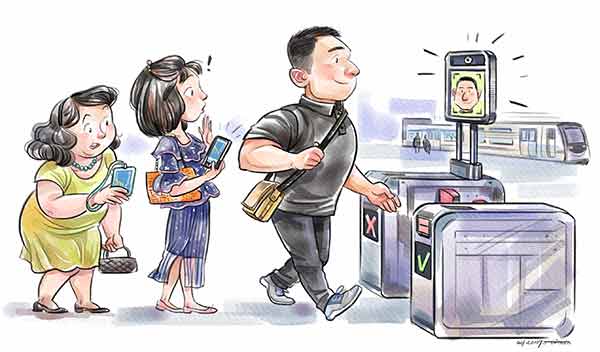
Editor's Note: Beijing metro is reportedly developing a new system to allow passengers to enter and exit the stations with facial recognition, which could become operational by the end of this year. A technological expert and a lawyer share their views on the issue with China Daily's Zhang Zhouxiang: Excerpts follow:
System safe as well as helpful in many ways
Li Junhong, head of R&D at Beijing ViSystem Corporation
Some people doubt the accuracy and reliability of the facial recognition technology. They need not, because the technology is highly sophisticated. It can distinguish a human face with or without glasses, and recognize it from the front based on data analysis.
Tests show it has a precision rate of more than 99 percent. Considering that the light beams are stable and passengers generally avoid making exaggerated expressions in subway stations, the precision rate can be higher and the errors negligible.
Some argue that the fingerprint or iris recognition system is perhaps more accurate than the facial recognition system. True, but for iris recognition, a person has to hold his or her head still and look into the camera, which is time consuming and thus not suitable for public facilities such as subway stations.
And the fingerprint recognition system is not so secure, as some people can cheat the system by copying and using the fingerprints of other people to enter or exit a station. In comparison, it is difficult to cheat the facial recognition system, as it recognizes human faces on cubic, not flat, models. A facial recognition system collects people's facial images from different angles, instead of one, and therefore minimizes the chance of cheating.
Facial recognition is a rather mature system. Actually, it is already being applied in many fields such as unlocking smartphones and computers.
Besides, facial recognition technology can also help the police to hunt escaped convicts and terrorists in public spaces. The police can input the facial images of suspects into the system, and it will automatically compare them with the passengers using the subway stations, identifying them when found. The technology has already helped police nab some escaped convicts, and it may play an equally vital role in subways.
Can't function without passengers' consent
Cui Zhendong, a lawyer at Yiqian Law Firm
In order to allow a passenger to pass, a facial recognition system must collect the passenger's biological information, mainly facial images first and compare them with those stored in its memory. The law says a citizen's photograph (or set of images) should not be collected for commercial use without his/her consent. And since Beijing metro is a commercial company, it may face legal risks using a facial recognition system without the passengers' consent.
To avoid such legal risks, Beijing metro should take some measures before collecting the information of passengers. First, it must draft rules and take strict inner-control measures to ensure the collected facial images are only for ticketing use, that is, for public convenience, and will never be used for other commercial purposes, such as advertisements.
Second, since Beijing metro will be responsible for the safekeeping of the collected facial images, it must take necessary measures to make sure not even a single one is leaked or sold to any third party without the passenger's consent.
Third, the subway company should persuade each passenger to sign a written or electronic contract before he/she joins the facial recognition system, so that it is not sued in court later for breach of privacy. For those who refuse to sign the contract, a passage should be kept open so they can enter and exit a station by swiping their card.
Advanced technologies are welcome to be used in public facilities such as subway stations, but people's rights must be respected, at least to avoid legal risks.





