Annual vehicle taxes cut for NEVS, small engine cars









China continues drive to reduce fuel consumption in auto sector
China has scrapped vehicle and vessel taxes on new energy vehicles and cut them by half on cars with smaller engines, one of the country's latest financial stimuli to cut fuel consumption and encourage cleaner energy use, the Ministry of Finance announced last week.
The vehicle and vessel tax, which is paid annually by car or ship owners, varies from region to region in the country, but normally runs between hundreds of yuan to thousands of yuan depending on engine sizes and the capacity of vehicles or ships.
Analysts said the measure may help boost sales somewhat but will not produce huge impacts immediately as the sum is not significant considering cars' price tags, but they added that it shows the authorities' attitude toward new energy vehicles and smaller cars.
China is to develop a leading new energy vehicle sector as part of efforts to build a globally competitive automotive industry within 10 years, according to a guideline released by the Ministry of Industry and Information Technology last year.
Among others, it expects sales of electric vehicles, plug-in hybrids and fuel cell-powered cars in the country to reach 2 million by 2020, and such cars are to account for 20 percent of all vehicle sales by 2025.
The blueprint has attracted both Chinese and international carmakers to introduce new energy models into their lineups.
China-based BYD Co has become the best-selling new energy car producer in the world.
Volkswagen AG has said that it will have released around 40 new energy models in the Chinese market in the next seven years.
From January to June this year, 412,000 electric cars and plug-in hybrids were sold in the country, up 42.9 percent year-on-year, according to statistics from the China Association of Automobile Manufacturers.
The association expects the sales this year to exceed 1 million units from less than 800,000 units last year. China has been the world's largest new energy car market since it overtook the United States in 2015. Besides the vehicle and vessel tax, new energy vehicles are currently also exempt from the purchase tax, which stands at around 10 percent of their price tags.
The stimulus, which took effect from January this year, will run through to 2020, according to the Ministry of Industry and Information Technology.
It came as an extension of a favorable policy that started in 2014.
The halved vehicle and vessel tax will drive sales of cars with engines smaller than 1.6 liters as well, as the favorable purchase tax policy for them was revoked by the end of last year.
The policy was introduced in September 2015 in order to facilitate growth in the small vehicle sector, which analysts said achieved significant results and more importantly encouraged customers to accept more smaller environmentally-friendly models.
A total of 1.33 million vehicles with engines no larger than 1.6 liters were sold in October that year, up 16.3 percent from the previous month, according to statistics from the China Association of Automobile Manufacturers.
Now that the government is halving the vehicle and vessel tax on such vehicles, some carmakers are seizing the opportunity to boost sales by offering extra incentives.
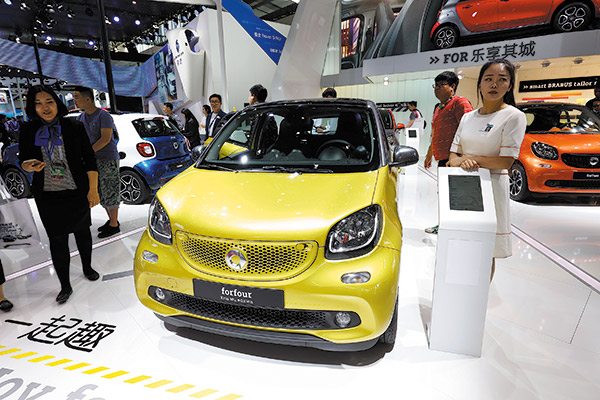
Mercedes-Benz said it would pay the rest half of the tax on up to 20 models under its namesake brand as well as all models bearing the smart marque from Aug 1.
Cui Dongshu, secretary-general of the China Passenger Car Association, said: "The new stimulus will help more customers change their stereotypes about smaller engines like those with three-cylinder ones, which has a lot of potential in the country in fuel consumption before new energy cars become the mainstream choices."
Statistics from the association show that in the first half of the year cars with engines smaller than 1.6 liters accounted for less than 50 percent among SUVs, and merely 20 percent among sedans and MPVs in China.
Sales of such vehicles from January to June grew 3.3 percent year-on-year, according to the China Association of Automobile Manufacturers. It did not disclose their specific sales number.