



US law criticized as stoking conflict









Act interferes in domestic affairs, Beijing warns
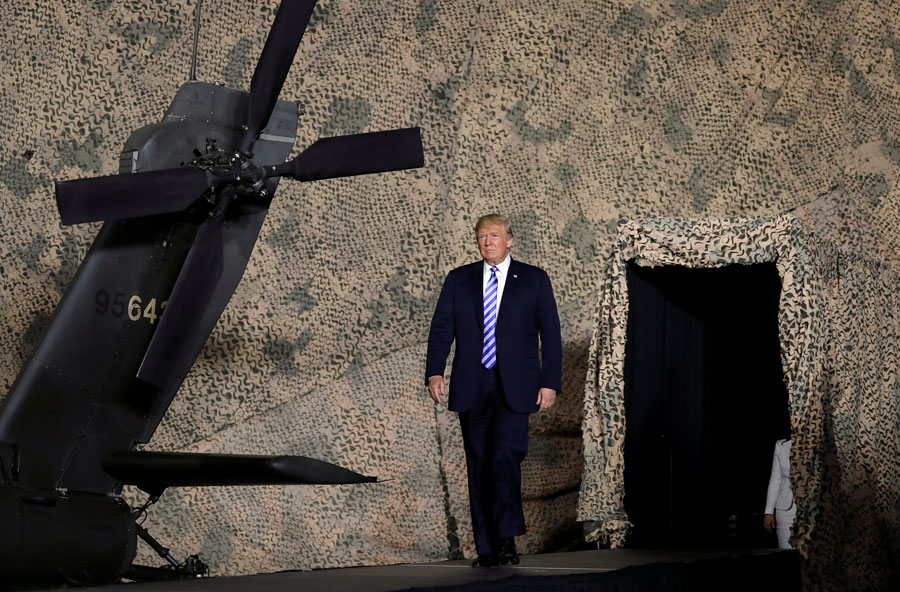
Beijing bashed Washington on Tuesday after United States President Donald Trump signed into law the National Defense Authorization Act for Fiscal Year 2019, which includes measures undermining China's territorial sovereignty and core interests.
Experts said the language used in the act sets a "dangerous precedent" by reviving Cold War paranoia, leading to possible arms races, regional tensions and mistrust in global relations.
Measures against China in the new act include issuing public reports on China's activities in the South China Sea, and banning China from future Rim of the Pacific Exercises, a biennial naval event led by the US in Hawaii.
A section of the law is also dedicated to US plans to enhance Taiwan's defensive capabilities. These include strengthening exchanges between senior defense officials, increasing US arms sales to Taiwan and exploring opportunities for practical training and military exercises.
Senior Colonel Wu Qian, a spokesman for the Defense Ministry, said on Tuesday that the act tries to interfere in China's internal affairs and stoke Sino-US conflict, and that it operates from a Cold War mentality.
Wu said the act goes against the one-China policy, damages the development of Sino-US military-to-military relations and undermines mutual trust and cooperation between the two countries.
Lu Kang, a spokesman for the Foreign Ministry, called on the US to abandon its Cold War thinking and zero-sum mindset, and to uphold the one-China policy and joint communiques made by both countries.
Ma Xiaoguang, spokesman for the State Council Taiwan Affairs Office, asked the US to halt arms sales to Taiwan in an online statement on Tuesday, saying failure to do so might damage regional peace and security, as well as Sino-US relations.
Ma also warned the island's "ruling" pro-independence Democratic Progressive Party not to leverage foreign powers for its own gain, because doing so will "inevitably damage the interests of the Taiwan people".
While past US defense reports have portrayed China as a competitor, this is the first time for the US to explicitly state "long-term strategic competition with China" as its "principal priority", said Senior Colonel Zhao Xiao zhuo, director of the Secretariat's Office of the Xiangshan Forum, an annual security conference in Beijing.
"The US views China and Russia as the primary challengers to its strategic interests, similar to the Cold War era," Zhao said. "But this time, the report suggests that China has the potential to take the former Soviet Union's place as an all-around competitor to the US."
Therefore, the US is boosting its military to an unprecedented scale to ensure its global dominance through advanced military hardware, such as in space, cybersecurity, artificial intelligence and underwater warfare, he added.
The act authorizes $717 billion in military spending for fiscal year 2019, which lasts from Oct 1 to Sept 30, 2019.
The new budget has seen a 3.5 percent increase over the $692 billion budget from the previous fiscal year, marking the largest military budget in US history, according to the Pentagon.
Li Haidong, a researcher of US studies at China Foreign Affairs University, said the Cold War mentality reflected in the defense act will undoubtedly disrupt global peace and security.
"Although Sino-US relations have not yet entered a new Cold War, the future of bilateral ties will be rocky in the next few years," the researcher said.
However, while the US is poised for full competition, Zhao said it is not in China's interest to return the hostility because China does not seek global hegemony, nor does it want unnecessary conflicts or arms races.
"There is simply too much to lose when two nuclear powers butt heads militarily," Zhao said.
"But China also needs to stay cool and firmly protect its core interests, which the new defense law clearly tries to undermine."










