Let's clear our minds now and get this straight: on Thursday the Hall of Mental Cultivation had been closed to the public for exactly 1,000 days - the official reason being that it was being repaired - and we're still counting.
But a couple of weeks ago, anyone thinking the hall, part of the Palace Museum in Beijing, also known as the Forbidden City, must surely reopen its doors again soon, received an ice-cold shower. That came grace of Shan Jixiang, the museum director, who jauntily informed assembled media on Sept 3 that the repair work was in fact just about to begin.
So what on earth have those armies of repair personnel been doing for the past two years and eight months?
To explain it all, Shan took the medical route.
"It's like doctors doing tests to get an absolutely accurate diagnosis before they treat a patient," he said. "If you first get a complete picture of where things stand with the architecture it makes the restoration work itself a lot easier."
Considering the huge complexity of this operation it is easy to sympathize with Shan.
The Hall of Mental Cultivation is a key site in the museum, China's imperial palace from 1420 to 1911, and it covers 2,540 square meters. It was first built during the late Ming Dynasty (1368-1644), and the last eight emperors of the Qing Dynasty (1644-1911) used it as a living room.
More than 2,000 exquisite art pieces and daily-use royal artifacts were moved out of the hall, some being exhibited in cities including Beijing, Hong Kong, Nanjing and Jinan.
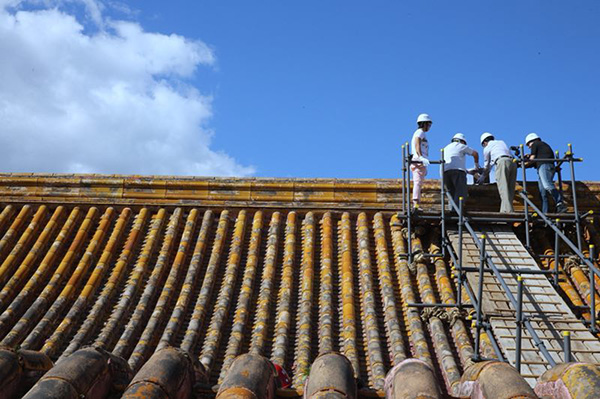
In-depth research of the tiles, the walls and every inch of the beams and columns, a process called "archaeology on the roof", was done not only to accurately spot damage done over the centuries, but also as the basis of 33 academic studies.
"Every wall tells a story, and each of those stories is waiting to be told," Shan said. "For example, the building has often gone through repairs over the centuries, and numerous records have been made. We need to check whether the vestige of previous restorations matches the records."
The latest research results were displayed in a temporary exhibition in the museum from August until early September.
There are other reasons for the delay in restoration work beginning, too.
Until recently there were simply not enough competent people in this kind of restoration work whom the museum could call on, but in late August 116 qualified restorers graduated from a program tailored to teaching the skills required to do the restoration work in the Forbidden City.