



Tiangong II pushes new research boundaries









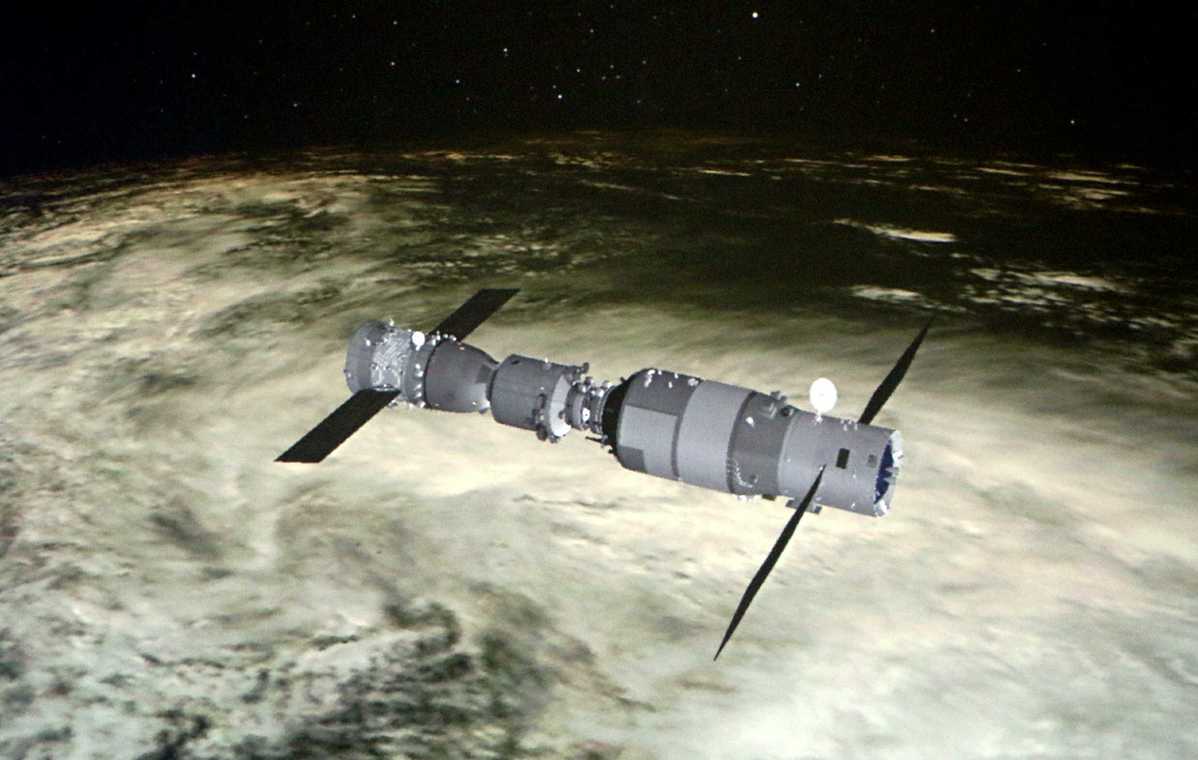
Tiangong II carries a payload of 600 kilograms in total. It is conducting research ranging from particle physics to materials science and remote-sensing technologies, according to the engineering office.
In late 2016, Tiangong II docked with Shenzhou XI and hosted two astronauts, Jing Haipeng and Chen Dong, for 33 days in China's longest human space flight mission to date.
Last year, it was visited by the Tianzhou I cargo spacecraft to test and verify refueling capabilities in microgravity, making China the third country, after Russia and the United States, to master the technique. Such capability is crucial to maintaining a space station.
The 10.4-meter-long, 8.6 metric-ton Tiangong II also tests advanced life support systems for astronauts who will man China's upcoming space station, whose core module will be launched around 2020, with the entire station set to be completed about two years later, CMSEO said.
Lin said the country's manned space program is also expanding its global cooperation and exchanges to jointly promote the peaceful use of space technologies, adding China has already cooperated with Russia, France, Germany and Italy.
As of Oct 3, China had received 36 international science cooperation project proposals from 25 countries and regions for its space station, Lin said. The projects cover a range of topics including astrophysics, medicine, life science and bioengineering.
"China will continue to uphold the principles of peaceful, fair and mutually beneficial use of space technologies, and expand exchanges and cooperation with other countries," Lin said.
On Oct 12, Chen Jie, director of general planning at CMSEO, said China has established a 37-member committee to set various technical standards for its space station. These standards are expected to be completed by 2020.
They will cover research and development of manned space technology, its applications and related services, said Chen, adding that the new standards represent a breakthrough in China contributing its knowledge to "space-related international norms".
The International Space Station, the only one in operation, will be retired in 2024, although efforts are being made to possibly extend this to 2028 or beyond. But this risks pushing the station's hardware close to its certified operational limits, according to NASA.
It also means China could become the only country with a functioning space station capable of critical in-orbit research after the international station is retired.
In the meantime, Tiangong II's payloads are operating in good conditions and carrying out experiments as planned, said Guo Lili, director of payload operation at the Technology and Engineering Center for Space Utilization of the Chinese Academy of Sciences, or CAS.
"Tiangong II's new chapter of scientific research and discovery has just begun," she said.


- Five new colors enhance rapeseed flower appeal
- US student finds connection to China through classical poetry
- Tongzhou launches legal service mini-program to aid enterprises in global IP challenges
- Xi'an hosts Belt and Road youth for Chinese Language Day
- Guangdong sees its GDP rise to over $500b in the Q1
- Sichuan libraries register big jump in readership





