


Category of site: Cultural Site
Brief introduction
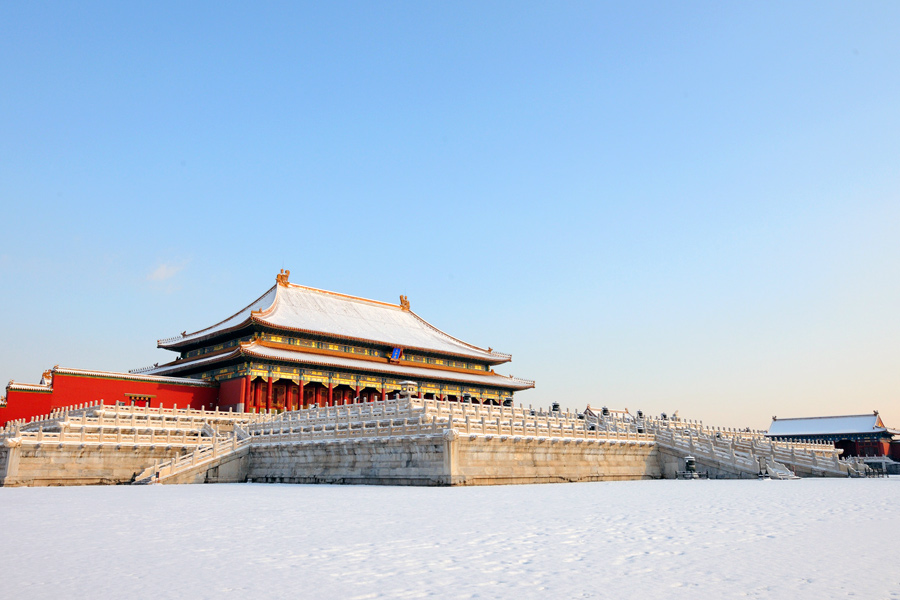
The Forbidden City, located in the center of Beijing, used to be the imperial palace of the Ming and Qing dynasties. Its construction started in 1406, and was completed in 1420. The rectangular palace covers an area of some 720,000 sq km - 961 meters in length and 760 meters in width. It has a total of 9,999.5 room spaces (an area enclosed by four poles). In 1924, the imperial family of the Qing Dynasty was removed from the Forbidden City, and in 1925 the Palace Museum was established here.
The Forbidden City has four entrance gates: the main Meridian Gate (Wumen) to the south, the Eastern Flower Gate (Donghuamen), the Western Flower Gate (Xihuamen), and the Gate of Divine Prowess (Shenwumen) to the South. The palace grounds are divided into two parts: the Front Palace (Qianchao) to the south and the Inner Palace (Neiting) to the north. The Front Palace consists chiefly of three magnificent and solemn halls - the Hall of Supreme Harmony (Taihedian), the Hall of Central Harmony (Zhonghedian), and the Hall of Preserving Harmony (Baohedian). The Inner Palace includes the Palace of Heavenly Purity (Qianqinggong), the Hall of Prosperity (Jiaotaidian) and the Palace of Earthly Tranquility (Kunninggong).
Built in 1624, Shenyang Imperial Palace, which is 380 years old, is one of the few historic Chinese sites that epitomize an ethnic minority culture.
The Imperial Palace of the Qing Dynasty in Shenyang follows the traditions of palace construction in China and maintains typical characteristics of traditional folk residences of the Manchu people, and has integrated the architectural arts of Han, Manchu and Mongolian ethnic cultures. The building's layout was based on the "eight-banner system", a distinct social organization system in Manchu society, an arrangement unique among palace buildings.
The Imperial Palaces of the Ming and Qing dynasties in Beijing and Shenyang were added to the World Heritage List in 1987 and 2004.





