


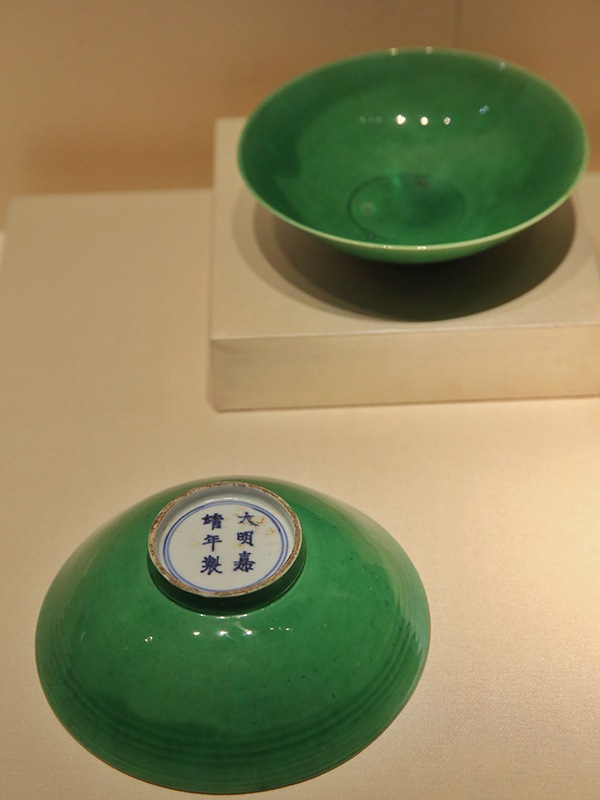
"The decorative patterns became more complicated," Lyu says. "Colors got flamboyant, sizes grew bigger, and bizarre shapes were favored-reflective of the economic prosperity of the time and the indulgent lives people led."
In the late Ming Dynasty, capitalism also guided tastes in ceramics, but the changes were such that the decorative elements in the later Ming era were not as "exquisite" as earlier examples. In addition, there were changes in the management system of the imperial kiln in Jingdezhen at the time.
In the early years of the kiln, the studios making royal porcelain were separated from the production of items designated for general use. But the porcelain-making technique had improved in general by the time of Emperor Jiajing's reign, and the turnover of the royal kiln could not meet the demand.
"Some privately-owned kilns were finally given the green light to make porcelain for the emperor (Jiajing) under official supervision," Lyu says. "Some samples of these are also being exhibited."
Work at the imperial kiln was officially halted in 1603, and product contracts were given to privately-owned kilns. It was reopened 80 years later during the Qing Dynasty (1644-1911).
Not all exhibits are intact, and some are excavated broken porcelain pieces. Lyu says they are equally important references for researchers to have a whole picture of the industry as it was back then.
Studies of unearthed relics from the royal kiln show the existence of at least 37 kinds of porcelain ware during Jiajing's rule, indicating the boom in ceramics, as well as craftsmanship. A type of "melon skin porcelain", which is glazed in green color and looks like a watermelon, reached its peak popularity in the Jiajing era, even though it appeared in the early Ming Dynasty.





