


Caught in an unending twirl









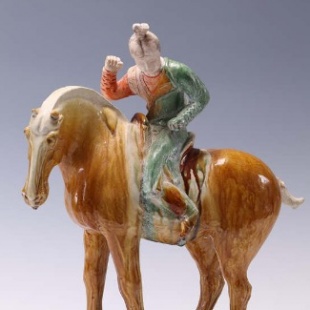
"Hu dress, Hu sound, Hu food and Hu religion - those were four main aspects that came to influence and encompass the life of a local Chinese living during the Tang era, especially its first half between the seventh and eighth centuries."
Of all, the Hu sound, and the dance that came with it, had the most fanfare and vivacity.
It is easy to imagine that the music and the dance served to soothe ruffled souls as people traveled the physically and mentally challenging journey on the Silk Road, sometimes at risk of their lives. Occasionally appearing on the back of a porcelain camel is a stringed musical instrument whose big belly and crooked neck set it apart from similar ones that Chinese used at the time.
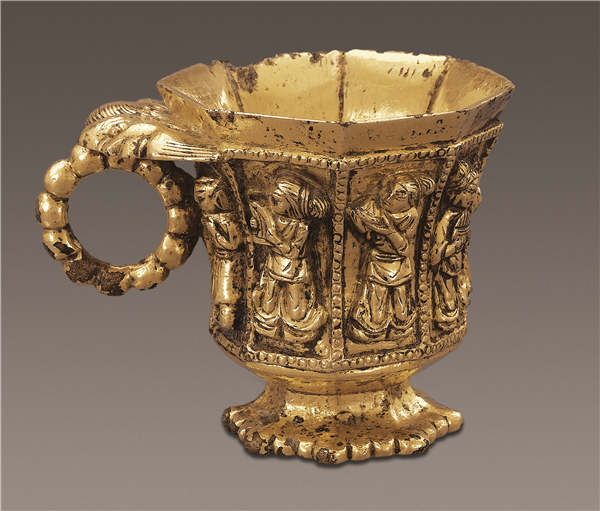
Images of music performers and dancers found their way onto everything from the exterior of an octagonal gilt bronze cup unearthed in Xi'an to that of a flattened flask discovered in Luoyang. In the case of the cup, its side is divided into eight facets, each featuring a panel decorated with the chiseled image of a Sogdian musician.
A more vivid group portrait involves ceramic renditions of five musicians and a storyteller, unearthed in a Tang tomb on the outskirts of Xi'an. With their Sogdian identity clearly established through both facial features and dress style, these men were engaged in performance requiring a high degree of coordination. The tacit consensus among these men, as well as the depth with which they allow themselves to be absorbed into the narration, was captured in a fleeting moment of interactive gestures and intense expression. The story told must be one about their own home.
Moments of deep lamentation there certainly were, but the Sogdians, whose entrepreneurship was matched by admirable daring, were never short of vim.
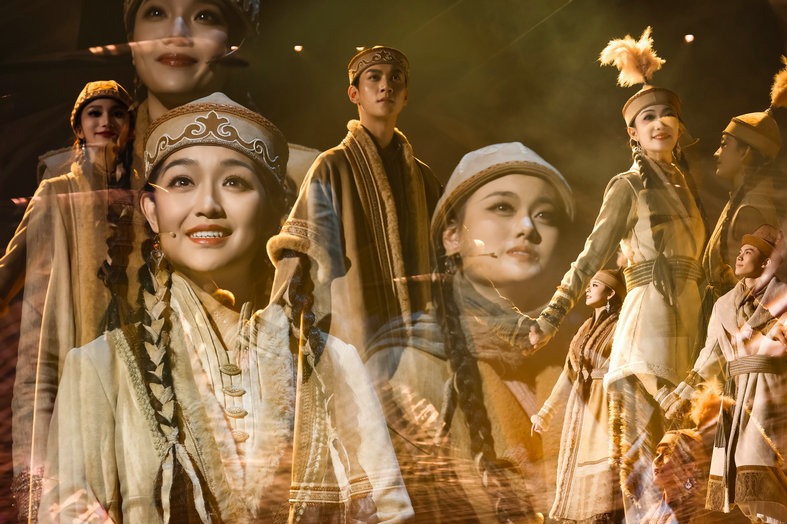
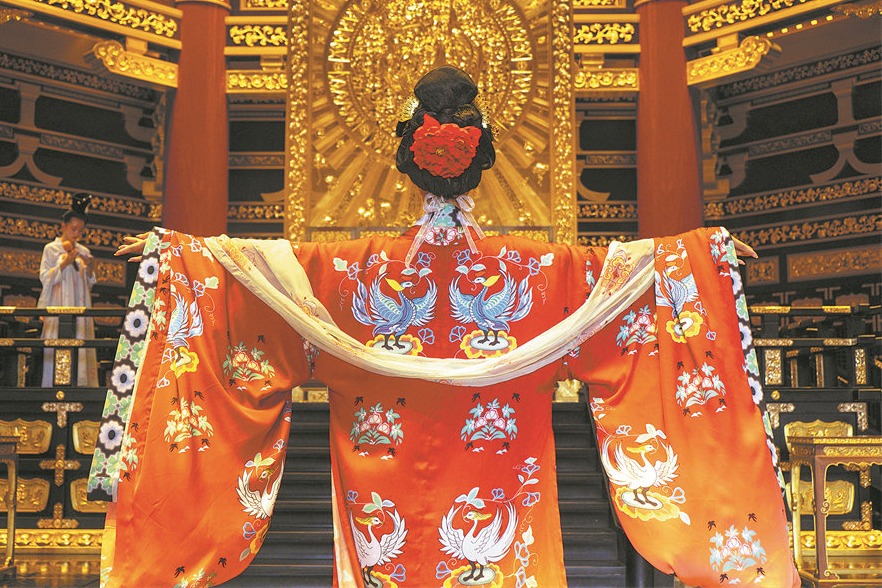
And whatever lay ahead, they could always stage a twirl, with a signature leap that led the dance being dubbed Hu Teng Wu or Hu Xuan Wu, meaning literally the dance of leaping or twirling.
The dance provided an apt metaphor. During the heyday of the ancient Silk Road, the Tang Empire had a passion for all things foreign, a passion that can now be seen as full blooded infatuation.
In 755 the empire and its ruler, Emperor Xuanzong, were yanked out of their reverie by internal rebellions led by two of its military governors of border regions. Both men were of Sogdian origin.