


Category of Site: Cultural site
Brief introduction
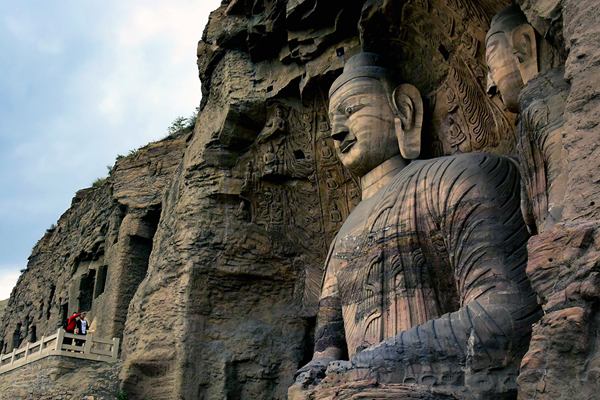
Located at the southern foot of the Wuzhou Mountain, some 16 km west of Datong city, Shanxi province, the Yungang Grottoes were built against the mountain and extend about one km (0.62 miles) from east to west. Comprising 252 caves and 51,000 statues within a carved area of 18,000 square meters, Yungang Grottoes represent the outstanding achievement of Buddhist cave art in China during the 5th and 6th centuries. The Five Caves created by Tan Yao, with their strict unity of layout and design, constitute a classical masterpiece of the first peak of Chinese Buddhist art.
While influenced by Buddhist cave art from South and Central Asia, Yungang Grottoes have also interpreted the Buddhist cave art with distinctive Chinese character and local spirit. As a result, Yungang Grottoes have played a vitally important role among early Oriental Buddhist grottoes and had a far-reaching impact on Buddhist cave art in China and East Asia.
Yungang Grottoes were added to the World Cultural Heritage List in December 2001.
Cultural heritage
The 53 grottoes in Yungang include some 1,000 niches with about 51,000 statues - a treasure trove of grotto art that combines traditional Chinese art forms with foreign influence, particularly Greek and Indian. The Yungang Grottoes are also a treasure house of ancient Buddhist art, the largest of its kind in China. They are as famous as the Longmen Grottoes in Luoyang and Mogao Grottoes in Dunhuang, Gansu province.
The numerous niches set in the northern cliff of Wuzhou Mountain look like a honeycomb. The grottoes, a plethora of Buddhist statues, are composed of three parts. The early rock caves (five) in the west, which are mostly oval-shaped and large, with the main statue reaching 17 meters tall. The grottoes in the middle, oblong in shape and in two chambers, with the main statue in the center and the walls, arches and roofs covered with Buddhist relief sculptures. The square grottoes, each with a pagoda-shaped central column, are also excellently sculptured.
Caves 1 and 2 are located in the east zone. Inside the entrance to the Yungang Temple is an impressive four-story wooden facade with a glazed top outside Caves 3, 4 and 5. Grotto No 5 contains a seated Buddha - 17 meters tall. In Cave 6, a 15-meter-high two-storied pagoda pillar stands in the center of chamber, and the life of the Buddha from birth to the attainment of Nirvana is carved in the pagoda walls and sides of the cave. The Bodhisattva was engraved in Cave 7. The rarely seen Shiva Statue in Yungang, with eight arms and four heads, riding a bull, is illustrated in Cave 8. Cave 9 and 10 are notable for their front pillars and figures bearing musical instruments. Musicians playing instruments also appear in Cave 12. Cave 13 has a Buddha statue with a giant figurine supporting its right arm. Cave 14 has eroded severely. Cave 15 was named the Cave of Ten Thousand Buddha. The caves numbered 16 to 20 are the oldest complex and each symbolizes an emperor from the Northern Wei Dynasty, with the subject of "Emperor is the Buddha". The caves from Cave 21 onward were built later and cannot compare to their better-preserved counterparts.





