


China's 40 Years: Ups and downs of Chinese films









In 1988, Zhang Yimou's "Red Sorghum" received the Golden Bear award at the 38th Berlin Film Festival. It was the first time a Chinese film took home the crown of one of the most renowned international film festivals.
Another title from Zhang, "The Story of Qiu Ju," also snatched the Golden Lion award at the Venice Film Festival in 1992, while its leading actress Gong Li pocketed China's first Best Actress award at the event.
Chen Kaige, also a representative of the "fifth generation" of Chinese filmmakers, won the Palme d'Or award at the 1993 Cannes Film Festival with "Farewell My Concubine."
Within 20 years after the reform and opening-up policy, Chinese filmmakers bagged Europe's three top awards.
In 1993, the Chinese film industry welcomed its first turning point by exploring reforms of the market system and mechanism. A year later, when the first Hollywood film "The Fugitive" debuted in China, long queues were seen in front of theaters in Beijing as moviegoers raced to watch the imported title.
During the next decades, while breathing new life into the Chinese film industry, foreign films also brought about a great impact to domestic productions. By the late 1990s, domestic films accounted for only less than 30 percent of the box office.
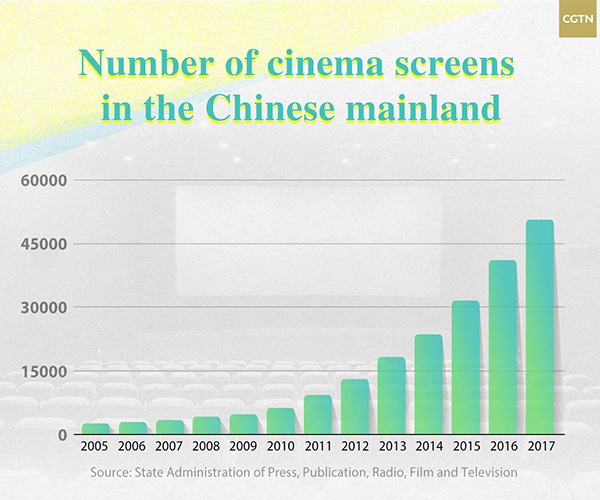
The second turning point for the Chinese film industry emerged in 2002, when the country deepened reforms and introduced the "cinema line system."
Every aspect of the film industry, including the production, distribution and projection was open to the market. Investment became diversified, and private film companies began to play an increasingly important role in film production.
In 2004, the box office of China's domestic films surpassed that of imported titles for the first time. In 2010, the Chinese film box office exceeded 10 billion yuan and two years later, China surpassed Japan to become the second largest film market in the world.