The 750 precious artifacts range from Neolithic times to the Qing Dynasty (1644-1911), covering nearly the entire history of Chinese civilization.
They would have been lost if not for the country's commitment in recent years to fight crimes involving such cultural treasures.
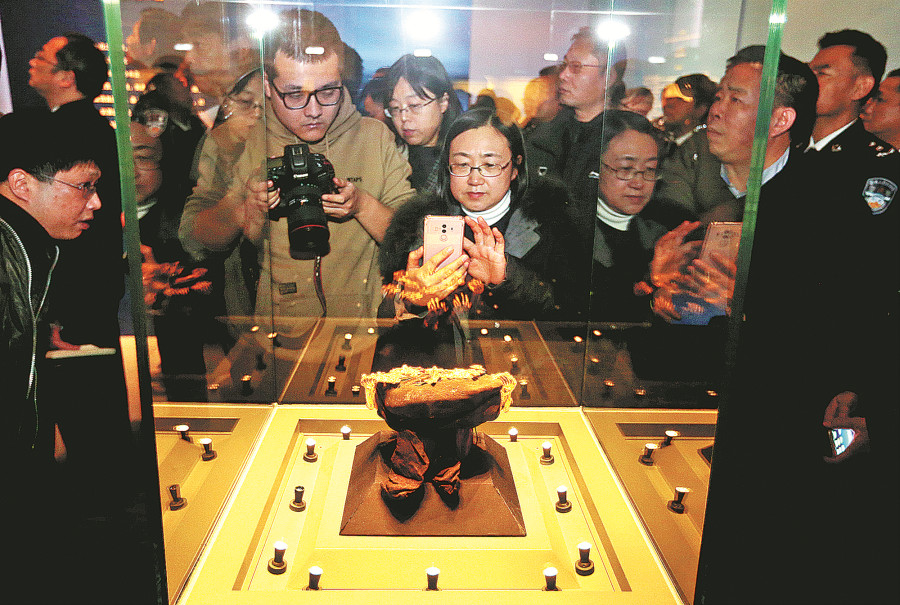
Now the public will get a chance to see them. A monthlong display, Guarding Civilization with Concerted Efforts: Exhibition of National Crackdown on Crimes Related to Cultural Relics, opened on Wednesday at the National Museum of China in Beijing.
Some 160 exhibits are listed as the country's highest-level key cultural relics, according to Le Rile, the museum's curator of the exhibition.
They include a C-shaped jade dragon and an ox-headed jade figurine from Hongshan culture, dating back more than 5,000 years and found in Liaoning province.
There's a gold seal from Sichuan province used by rebels near the end of the Ming Dynasty (1368-1644) and many funeral objects belonging to the Marquis of Haihun, who was briefly emperor during the Han Dynasty (206 BC to AD 220).
The exhibition includes many bronze objects, porcelains and decorative pieces.
"It's the first time that China has held such a national-level exhibition to show our achievements in fighting crime that endangers cultural relics," Le said.
One section highlights 14 major cases and how authorities traced and recovered lost treasures.
"There is still a serious problem with ensuring the protection of our heritage," said Liu Daming, deputy director of the office of legal supervision at the National Cultural Heritage Administration. "Robbery, theft and smuggling of cultural relics are still prevalent."
Ancient tombs, city ruins and stone carvings in the countryside are the main targets, he said. Since 2013, there have been over 100 cases at sites with national-level key protection. Some World Heritage sites also have been targeted, including the mausoleums of Ming and Qing emperors in Beijing and Hebei province and the Yinxu city ruins of the Shang Dynasty (c. 16th century-11th century BC) in Henan province.
Still, China has endeavored to fight against such historical depredations.
Gong Zhiyong, a supervisor at the Ministry of Public Security in charge of criminal investigations, said more than 5,000 cases involving relics have been solved since 2013, and approximately 10,000 suspects have been detained.
"Tens of thousands of cultural relics have been retrieved in such campaigns," Gong said. "The items on display are only a small portion of them.
"However, we're still confronted with many challenges. The appraisal of cultural relics involved in such cases requires a great deal of expertise, for example. And some organized gangsters also have participated in cultural relics-related crimes."
In the case of Yinxu, 14 gangs, including 148 suspects, had been captured by November and 713 artifacts retrieved.
Consequently, different departments are joining together to create a more solid line of defense. The Ministry of Public Security and the National Cultural Heritage Administration worked together to establish a national online platform for tracing lost cultural relics.
"We will continue to apply a great deal of pressure," Gong vowed. "We'll strike hard against these crimes and guard the integrity of our country's culture."
More than 5 billion yuan ($726 million) has been allocated by the central government since 2012 to improving security systems at warehouses for relics. The Supreme People's Court and the Supreme People's Procuratorate have released a series of judicial interpretation documents to facilitate the processing of legal cases.
Some relics in the exhibition at the National Museum of China are on loan from judicial authorities because they are evidence in criminal cases, Liu said, adding that those are especially good examples of the need to protect the nation's heritage.