NASA's New Horizons releases first images of entire new world









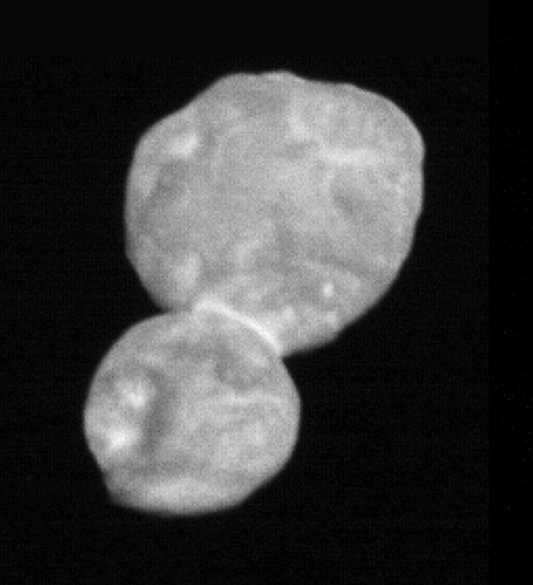
LOS ANGELES -- Scientists from NASA's New Horizons mission on Wednesday released the first detailed images of the most distant object ever explored - the Kuiper Belt object nicknamed Ultima Thule.
New Horizons performed the farthest flyby in history at 12:33 a.m. EST (0533 GMT) on New Year's Day, as it approached Ultima Thule within 2,200 miles (about 3,540 km) of the surface at a velocity of 31,500 miles (about 50,694 km) per hour.
The new images - taken from as close as 17,000 miles (about 27,000 kilometers) on approach - revealed Ultima Thule as a "contact binary," consisting of two connected spheres, said NASA.
End to end, the world measures 19 miles (about 31 kilometers) in length. The team has dubbed the larger sphere "Ultima" (12 miles/19 kilometers across) and the smaller sphere "Thule" (9 miles/14 kilometers across).
The two spheres likely joined as early as 99 percent of the way back to the formation of the solar system, colliding no faster than two cars in a fender-bender, said the team.
The appearance of Ultima Thule, unlike anything human have seen before, illuminated the processes that built the planets four and a half billion years ago, said NASA.
"New Horizons is like a time machine, taking us back to the birth of the solar system. We are seeing a physical representation of the beginning of planetary formation, frozen in time," said Jeff Moore, New Horizons Geology and Geophysics team lead.
"Studying Ultima Thule is helping us understand how planets form, both those in our own solar system and those orbiting other stars in our galaxy," he said.
Data from the New Year's Day flyby will continue to arrive over the next weeks and months, with much higher resolution images yet to come, said NASA.
"In the coming months, New Horizons will transmit dozens of data sets to Earth, and we'll write new chapters in the story of Ultima Thule - and the solar system," said Helene Winters, New Horizons Project Manager.
Ultima Thule, at 4 billion miles (about 6.4 billion km) from the Sun and 1 billion miles (about 1.6 billion km) from Pluto, will be the most distant object ever directly explored, according to NASA.