


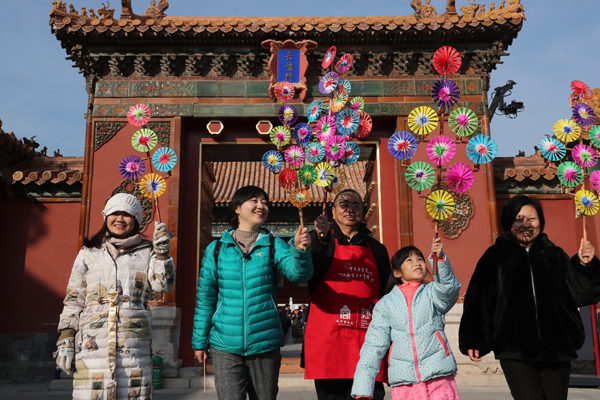
The Palace Museum is resurrecting the glory of imperial New Year's celebrations for holiday visitors, Wang Kaihao reports.
Whether the past year was good or bad, Spring Festival is a time to celebrate for every Chinese person.
People hope for an auspicious new year through myriad rituals. The emperors of old were no exception.
The Palace Museum in Beijing, which is also known as the Forbidden City, was China's imperial palace from 1420 to 1911. As the world's largest surviving palatial complex, the Forbidden City is famed for its abundant collection of cultural relics and brilliant architecture, revealing the grand royal power of its former inhabitants.
In the face of such grandeur, it is perhaps easy for visitors to overlook things that hint at the emperors' gentler emotions. Maybe, Lunar New Year is a good occasion to rediscover them.
Those visiting the Palace Museum over Spring Festival will find something new and warm the moment they step through its front gate.
Antithetical couplets and the auspicious images of "door gods" are hung on the gates to wish for prosperity and ward off evil spirits, while the eaves are decorated with lanterns in line with imperial tradition.
Wandering through the Forbidden City feels more like visiting a historical neighborhood bathed in a festive mood rather than a museum. However, one thing makes these royal decorations particularly different from others: Many couplets in the palace are written on white paper, unlike the red ones most visitors would have at home.
As the walls, doors and columns of the Forbidden City have all been painted in red, the emperors probably wanted to make these symbols of good fortune more visible.
Expecting good fortune
Though Qing Dynasty (1644-1911) emperors were ethnic Manchu people, they were willing to absorb the merits of Han culture. For example, emperor Qianlong, whose reign lasted from 1736 to 1795, also became a prolific calligrapher and poet.
On the first day of layue, the 12th month of the lunar calendar, the emperors would write their first fu (blessing) character of that year, kicking off another Lunar New Year season-but who was the best royal calligrapher? Well, people can now view the evidence and make their own judgment.
Fu characters written by five consecutive Qing rulers-Kangxi, Yongzheng, Qianlong, Jiaqing and Daoguang-are juxtaposed in the Meridian Gate Gallery, which is above the entrance gate of the museum.
They form part of Celebrating Spring Festival in the Forbidden City, one of the largest-scale exhibitions in the museum's history, which displays 885 cultural relics from the Qing Dynasty that are related to Lunar New Year.
To prepare for the event, more than 100 curators, led by the deputy director of the museum, Ren Wanping, have rummaged through pretty much all of the museum's warehouse. The exhibition, which kicked off on Jan 7, will run until April 7.
Because family reunions are the eternal theme of Lunar New Year, more than 100 cultural relics have been arranged to re-create the scene of a royal banquet during Spring Festival of 1783, based on detailed records of the event in the imperial files.
It is easy to see from the finished tableau that the emperor was a fan of hotpot.
There is a whole set of musical instruments to duplicate what the royal orchestra was like. When high officials expressed their Lunar New Year's blessings to the emperor, they needed some background melodies.
There was no CCTV Spring Festival Gala back then, so Peking Opera was the main holiday entertainment in the Forbidden City.
On Jan 9, workers who were renovating the Hall of Mental Cultivation-which was the residence of the last eight Qing rulers-discovered the performance program of a Peking Opera gala in a vent of the house.
It recorded a gala lasting for almost a day on Lunar New Year's Eve in 1826, that was set in three different locations and exclusively performed for the emperor.
The exhibition's curators immediately added it to the display, but so far, no one has been able to work out how it made its way from the emperor's hands into the vent.





