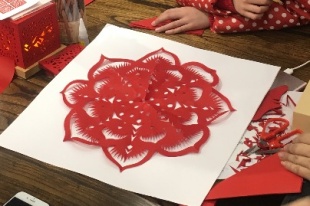



Cutting remarks: The hidden meanings of festive decorations









Yang has studied and performed the art for over a decade. Besides routine university courses, she also organizes nonprofit paper-cutting activities that are open to the public in Beijing to promote basic knowledge of the history and culture of paper-cutting.
Chen Xiaohong, who's the mother of an 8-year-old boy, attended one of Yang's courses in January.
"I often bring my son to such activities, though he cannot operate the scissors fully," she says.
"Sometimes we play together at home. He paints whatever is in his mind and I cut it out. He would explain to me what the patterns mean."
Yang says paper-cutting is an intangible cultural heritage that is well suited for sharing with the public. "It's easy to learn. The tools are cheap, and it can help you learn to be patient by doing delicate work."
Since the fragile material is hard to store, Yang designs products, such as lamps and Tangram puzzles, to "bring traditional art into modern life".
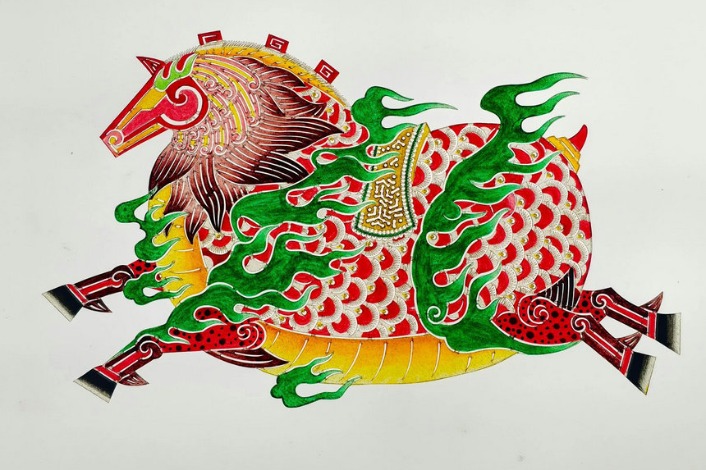
Every pattern on paper-cuts should have a symbolic meaning.
For example, fish swimming among lotus leaves, mice biting a pumpkin or an eagle grabbing a rabbit suggest fertility in ancient Chinese thought.
"Aggressive" or "mobile" subjects like the fish, mice and eagle usually represent men, while the lotus, pumpkin and rabbit represent the role of women, Yang explains. The invisible seeds represent babies.
"In the old days, the most important thing was to give birth to guarantee the continuation of the family line. That's why fertility worship is a common subject in Chinese folk art," she says, adding that paper-cuts with such patterns are often used at weddings.
Another important role of paper-cutting is to signify good luck. Patterns like clouds, flowers, bats, as well as the Chinese characters xi (happiness) and fu (blessed fortune), are considered auspicious and are commonly used as interior decorations during traditional Chinese festivals, such as Lunar New Year, Tomb Sweeping Day and Mid-Autumn Festival.
Images of toads, centipedes, scorpions and gourds are meant to stave off misfortune during Dragon Boat Festival. They represent the concept of "absorbing poisonous air and bad luck" and "generating fresh air".