


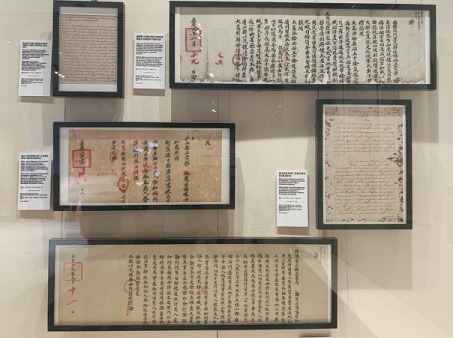
An exhibition of official records from Macao during the Qing Dynasty (1644-1911) from the National Archive of Torre do Tombo opened at Beijing's National Library of China on June 10.
The exhibition, Chapas Sinicas-Stories of Macao in Torre do Tombo, features more than 100 facsimiles of documents taken from a collection at the Portuguese national archive, titled the Official Records of Macao During the Qing Dynasty (1693-1886).
Housed in Lisbon, the collection comprises more than 3,600 documents and includes many official Chinese records and their Portuguese translations, plus other unofficial documents.
As well as diplomatic and public affairs, the archive offers a deep insight into Macanese society during the 18th and 19th centuries, touching on everything from daily life and social customs to urban construction, and trade and commerce.
Macao's significance as a key hub for China's external trade and interaction, and its pivotal role at the intersection of East and West, is apparent in the every aspect of the documents.
Known as the Chapas Sinicas (Chinese documents), the collection-which was named after the stamp that was placed on official correspondences-was jointly nominated by the National Archive of Torre do Tombo and the Archives of Macao before being successfully inscribed by UNESCO onto the Memory of the World Register in 2017.
The exhibition is an important component of a yearlong cultural festival held in both countries to celebrate the 40th anniversary of the establishment of diplomatic ties between China and Portugal, according to Luo Shugang, China's minister of culture and tourism.
This year also marks the 20th anniversary of Macao's return to China.
Exchanges between China and Portugal via the Maritime Silk Road date back to the 16th century.
During the Ming (1368-1644) and Qing dynasties, Macao was a trading port where Chinese and foreign ships anchored down the coast from Guangzhou.
The port, which used to be called Hao Jing Ao, was affiliated with Xiangshan county in Guangzhou prefecture and was a key center for shipping and trade with countries like Britain, France, Russia, the United States, Sweden, the Netherlands, Japan, Vietnam and the Philippines.
The Portuguese were permitted to stay in Macao from around the mid-16th century onward, but China maintained full sovereignty over the settlement by appointing officials and implementing laws and issuing decrees until 1849.





