



Trade talks can't solve America's twin deficits









The trade war truce agreed upon by President Xi Jinping and President Trump at the G20 Osaka summit is very good news for the economies of both countries. Highly disruptive breaks in supply networks and in established trading patterns will be avoided. Everyone from soybean farmers to high-tech companies can breathe a tentative sigh of relief.
But it is important to realize that no possible trade agreement can reduce the overall trade deficit of the US, which stood at $879 billion in 2018, or any other nation. A country's trade deficit is not determined by exchange rates or by tariffs. Instead, it is determined primarily by the domestic savings and investment rates within the country itself.
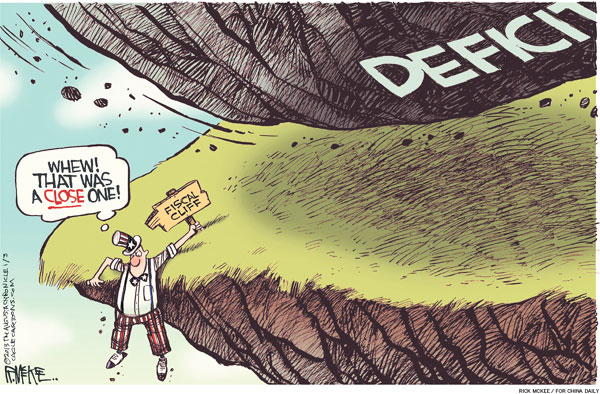
The US faces a coming crisis in its twin deficits - large and growing government budget deficits and trade deficits. Both are caused by a lack of savings.
I taught macroeconomics in a graduate-level executive management program for 17 years. My students, who were all experienced managers aged 40 to 50, found this hard to understand, or even believe. They would ask: "What's the connection between savings rates and trade deficits? Explain this again."
It's straightforward.
Americans don't save enough to pay for both the country's investment and the government budget deficit.
So, the only possible source of additional funds is from foreigners.
If a country saves less than it invests, then foreigners have to make up the difference. Written as an equation: savings minus investment equals exports minus imports.
For example, the US saves less than it invests, so it must import more than it exports. That is, it must run a trade deficit. This must be financed by some country, substantially China, that saves more than it invests and thus runs a trade surplus.
Foreigners don't send goods to America for free. They are, in fact, making a loan to the US. So, a trade must be balanced by an equal and opposite transfer of financial assets from Americans to foreigners. In practice, these assets are mostly US government debt - US Treasury bills.
Government spending is a form of consumption, so government budget deficits reduce the overall savings rate. Last month, the US Congressional Budget office released its annual long-term budget outlook projections. The conclusions, while expected, are still frightening.




















