


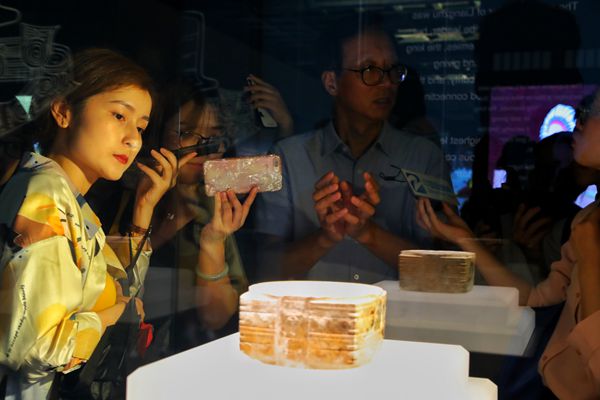
A new exhibition at the Palace Museum provides a panoramic view of the role played by jade in 5,000 years of Chinese culture, Wang Kaihao reports.
In 1748, the 37-year-old Emperor Qianlong of the Qing Dynasty (1644-1911) wrote an ode extolling the exquisite beauty of a fan-shaped jade artifact he owned, huang, after it was presented to him at the royal palace, the Forbidden City.
In his poem, the emperor attributed the antique to the Han Dynasty (206 BC-AD 220), but its exact age remained a mystery to him. In the following decades, many similar jade pieces were presented to him, and the emperor was so fond of holding them that they developed their own unique patina. He even added gold and enamel to the pieces for embellishment.
Nevertheless, the question of age kept bothering him. In 1778, he wrote another poem suggesting that these "Han objects" might belong to an earlier time.
But, as we know today, these objects are far older than the emperor could have realized.
The Qing ruler may not have been able to imagine that he was having a dialogue with an object dating back 5,000 years. However, modern-day visitors to the Forbidden City in Beijing, which is also known as the Palace Museum, can experience a panoramic view of the brilliant jade civilization of Liangzhu Culture, which was based in what is today's Hangzhou, Zhejiang province.
On July 6, the Archaeological Ruins of Liangzhu City in Hangzhou were inscribed onto the UNESCO World Heritage list, which recognizes the significance of the site as an indicator of the early stages of Chinese civilization. The city was inhabited for a millennium from 3300 to 2300 BC, according to archaeological research.
Just 10 days later, the exhibition Ancient China: A 5,000-year Civilization Demonstrated by Jade opened at the Palace Museum, just in time to feed public curiosity and unveil the charm of this realm of deities and kings. Nearly 260 objects, including Emperor Qianlong's precious jade collection, gathered from 17 museums and research institutes nationwide, have gone on display at the Hall of Martial Valor at the Palace Museum for this major occasion. The exhibition will run through Oct 20.
"Almost accidentally, Qianlong was probably the first researcher into Liangzhu jades," says Gao Menghe, chief curator of the exhibition and an archaeology professor at Shanghai's Fudan University, half-jokingly.
"As Liangzhu was one of the earliest known palatial cities in China, and the Forbidden City is the last royal palace of Chinese imperial times, we can feel an interesting chemistry running through time in this space," he says.





