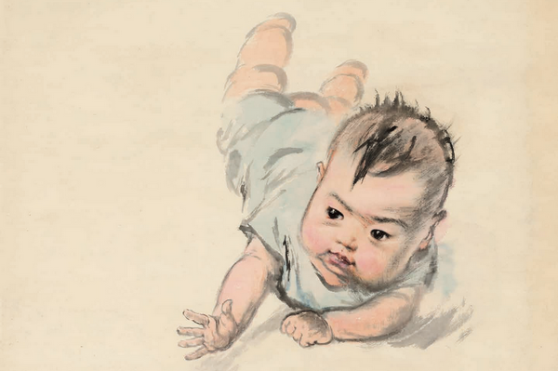
The display of paintings and drawings traces Qi's evolution from a rural painter who primarily produced work catering to the needs of the market, to a true artist who used carefree, abstract brushstrokes to express a generous spirit and a philosophical outlook on life.
Qi's path in life began with portraits. It was not until his 30s and 40s that he began specializing in landscape and nature paintings.
Qi once recalled that he painted his first figure around the age of 8 by copying a picture of Leigong, or God of Thunder, a deity in Chinese folk legend, that hung on the door of his family home.
"From then on, I developed an enormous interest in painting," he said of that watershed moment.
At the early stage of his exploration of art, Qi painted images of deities and portraits for people in his hometown of Xiangtan. These types of pictures were in high demand, bringing him a stable sideline income alongside his profession as a carpenter.
Meanwhile, he developed delicate techniques by painting images of female courtiers. The works on show demonstrate a popular trend of the late 19th century, when the typical features of fair ladies were depicted: a heart-shaped face, arched and elongated eyebrows, a small mouth, sloping shoulders and a body shape suggesting physical weakness, according to Xue Liang the exhibition curator.
Qi achieved such excellence in his technique that his paintings were hailed in his hometown as "beauties of a Qi style".
However, Qi grew discontented with this noticeably commercial style of painting. He began learning from the great painters of the 17th and 18th centuries. He moved away from accurate depictions and gradually adopted looser brushwork.
He painted fewer courtiers, choosing instead subjects like deities from Chinese folk legends, Buddhist figures or random people he met whose faces left an impression on him.
Xue says while Qi often used few lines and applied few colors, usually against a blank background; he was, however, able to create vivid faces and the nuanced differences in expression reveal the subjects' inner world and state of being.
Sometimes when Qi painted these figures, he was profiling his own mentality at the time. The paintings reflect his thoughts about life, people and the world around him.
"We have a saying that life is like a theater play," Wu says. "Under Qi's strokes there are men and women, old and young, deities and people of different walks of life, and at this exhibition, they are performing a play to engage the audience more deeply with Qi's world of art."