IoV will make driving a breeze









I love trying out different things but driving, until recently, wasn't one of them. My mind imagines driving to be a hazardous task that requires skills to negotiate sharp bends, bumps, irresponsible pedestrians, and vehicles zipping past me on narrow roads.
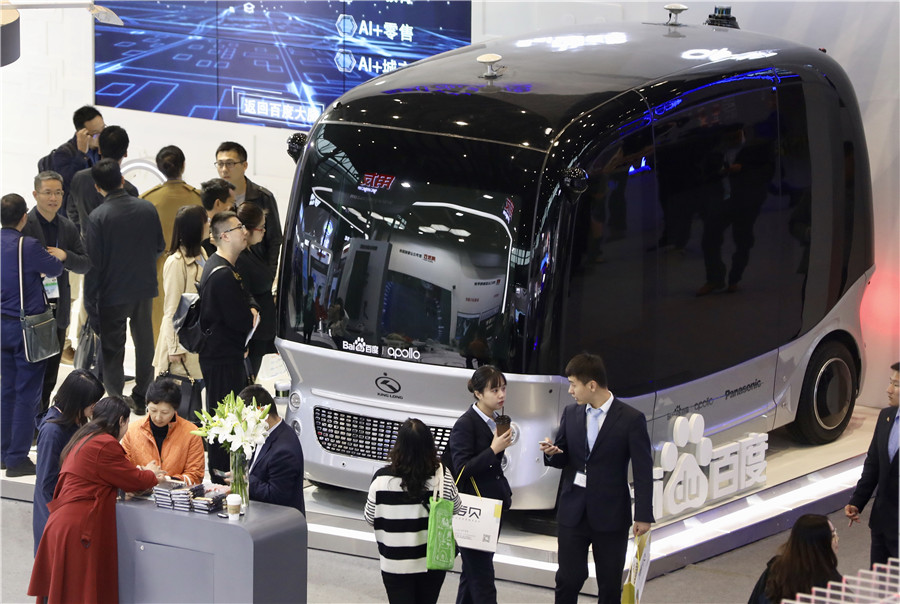
Could driving one day become totally stress-and risk-free? Yes, I'd argue, given that tech whizzes are intent on commercializing internet of vehicles, or IoV.
Mobility via surface transport could become safer when IoV allows network-based communication among people, vehicles and traffic infrastructure. It is the foundation of autonomous driving.
In the not-too-distant future, cars will be enabled by cutting-edge technologies to foresee potential traffic dangers and hazardous road conditions to avoid risks. I fancy learning driving sooner than later.
China has always stressed intelligent, connected vehicles, and the development of IoV, which is seen as a key way to relieve pressures on transportation, reduce energy consumption and minimize carbon emissions.
Miao Wei, minister of industry and information technology, disclosed at the Boao Forum for Asia in March that the ministry reached a major consensus with the Ministry of Transport to make traditional roads and related infrastructure "digitalized" and "intelligent".
Earlier this year, a highway project with IoV functions was launched in Shandong province. The 26-kilometer highway, built with technologies such as 5G telecom, three-dimensional maps and road sensors, opened in September. Other provinces, including Zhejiang, Hebei, and Gansu, are pushing forward "smart" highways to rev up the rollout of unmanned cars.
In Zhejiang, a "smart" highway between Hangzhou and Ningbo will be available by 2022. The 161-kilometer six-lane expressway can cater to speeds of up to 120 kilometers per hour. Also, the route will be embedded with IoV technologies, including navigation and cloud computing, to provide real-time services to driverless vehicles.
"From a long-term view, China is building the 'smart' highway for autonomous driving and intelligent collaboration between vehicles and roads. Also, the nation aims to gain a lead globally in the field," said Sheng Gang, chief engineer of the road design unit under the Ministry of Transport's Research Institute of Highway.
In the future, apart from smart driving, more amazing functions are expected from IoV. I'm all excited-can't wait to lay my hands on the wheel.
Oops, that won't be necessary. I just need to enter the car, take the driver's seat in the driverless car, and enjoy the views and the ride. For, the network will allow me to command the air conditioner, lights, gadgets, etc, installed in the car to switch on even before I board the vehicle, using no more than my voice.
With the popularization of the IoV, I can foresee myself transmitting documents online during the ride and video-chat with others in similar autonomous cars on the road.