



Consumption upgrade drives smart choices









In addition, the sales revenue of televisions, refrigerators and air conditioners stood at 63.1 billion yuan, 51.6 billion yuan and 118.9 billion yuan respectively in the first half of this year.
Midea Group, a leading home appliances maker in China, and Ali-Cloud, the cloud computing arm of Alibaba Group Holding Ltd, have announced they will carry out cooperation at a higher level in the field of smart home appliances.
The two parties will work together to develop tailor-made chips and an operating system platform for smart household appliances.
The smart home appliance products of Midea will be equipped with the customized chips of AliOS Things, which is a highly scalable internet of things operating system for the IoT domain under the AliOS family.
In March 2014, Alibaba and Midea inked a strategic partnership in IoT, a move that allows the traditional home appliances company to look for new growth points outside the saturated domestic market.
"Midea continuously promotes the development and technological innovation of smart home appliances, and actively participates in the establishment of international standards of such appliances," said Yu Shangfeng, general manager of Midea's IoT unit.
"China is one of the markets worldwide with the largest demand for smart appliances, but the industry faces challenges such as high R&D costs, fewer chip options and a long development cycle, and poor user experience," said Wei Wu, director of ecological cooperation of AliCloud IoT, while noting they are working on a "booster" for smart home appliance chips.
Moreover, Midea has inked a strategic partnership with Huawei in the area of smart homes. It also acquired German robotics manufacturer Kuka GA, bought more than a 50-percent stake in Israeli motion solution provider Servotronix Motion Control Ltd, and an 80-percent stake in Japanese home appliance manufacturer Toshiba Corp's white goods business.
Founded in 1968, the Foshan, Guangdong province-based company plays a leading role in areas including consumer appliances, robotics and industrial automation systems.
It is continuing to ramp up its research and development efforts to further develop its robotics and smart home appliances businesses.
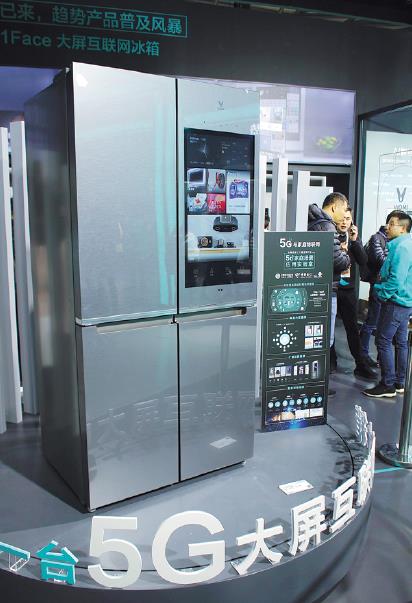
Statistics from All View Cloud showed the penetration rate of intelligent TVs in China reached 92 percent in 2018, the rate for intelligent air conditioners stood at 45 percent, intelligent washing machines at 24.5 percent and intelligent refrigerators 8.7 percent.
The smart home appliance industry is now developing by leaps and bounds, due to the advancement of AI, IoT, big data and other technologies, said Zhang Yanbing, an independent home appliance analyst.
He said the sector has a promising future, considering increasing requirements for a high-quality and intelligent life.
Internet heavyweights have marched into the smart home appliance market. Chinese tech behemoth Xiaomi Corp has launched a series of smart home appliances, such as air purifiers, cleaning robots, rice cookers and smart lamps under its sub-brand Mi Ecosystem.
Honor, one of the two signature smartphone brands of Huawei, launched its first smart TV called Honor Vision in August, marking the company's official entry into the TV sector.
It is also the first electronic product that is powered by its in-house operating system HarmonyOS, as Huawei is accelerating efforts to build its own software ecosystem for the era of IoT.
Zhao Ming, president of Honor, said the company hopes to leverage its years of innovation in smartphones to reshape the role of TV in people's daily lives.
"AI technology has been a driving force to propel the growth of the smart home appliance industry," said Liang Zhenpeng, an independent consumer electronics analyst.
Liang said voice interaction has been widely applied in the smart home field, and Chinese home appliances makers are improving their technological level in this sector to make products more intelligent.











