


All materials were transported by sea from Germany to Tianjin Port, and then delivered to Lanzhou via Beijing, Zhengzhou and Xi'an under the organization of the then foreign affairs office of Gansu province.
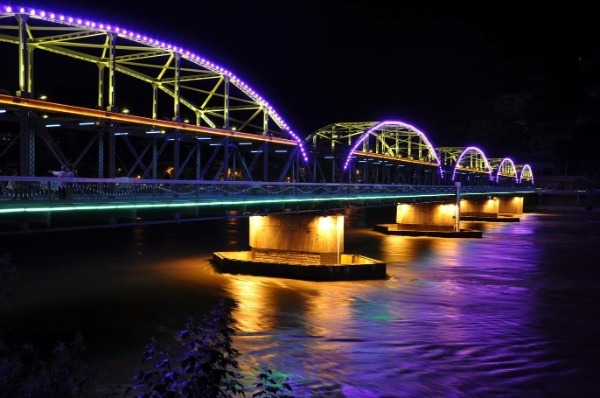
On February 21, 1908 (the 34th year of Emperor Guangxu reign), the Qing Government gave the official approval for bridge construction. The bridge was launched for use on August 19, 1909 (the first year of the Xuantong Period), three years later. The completed bridge, 234 meters long and 7.5 meters wide, had six piers and five arches. During the period, local government officer Mao Qingfan instructed the construction of a Chinese-style gateway at each end of the bridge and the gateways were completed on June 18, 1909.
Each gateway had a width of three rooms and depth of two rooms. Four inscribed plagues were put up, including two with inscriptions of "No. 1 Bridge" by the then local officer Sheng Yun at bridge heads, and other two plagues with additional inscriptions meaning the meandering Yellow River and the bounties bestowed by frontier areas, respectively.
On both sides of the bridge, two stone tablets with stories by Sheng Yun on the history of the bridge were installed. Upon completion of the bridge, the then foreign affairs office of Gansu province took 54 pictures of the bridge for review and record-keeping purposes by central and local authorities.
On April 25, 1910 (the second year of the Xuantong Period), the then governor-general of Shaanxi and Gansu provinces Chang Geng filed a report to the central government on verified costs of the project, including the warranty price, transportation price, and all expenses. "The actual paid cost is 306,691.898498 taels of plain silver."
In memory of the great Chinese democratic revolutionist Sun Zhongshan (also named Sun Yat-sen), the bridge was renamed Zhongshan Bridge by Sun's given name in 1928. The then provincial president Liu Yufen inscribed a name plague to be hung on the northern gateway. On August 26, 1949, the gateways and wooden boards were torched down during a battle to liberate Lanzhou.
The bridge floor was soon restored, but not the gateways. In 1954, the provincial government allocated 600,000 yuan for overall repair and enhancement of the bridge. During the project, five arched girders were added on top of the parallel chords. On August 9, 1898, shortly after getting hit by a water supply boat in the pier, the bridge was repaired and had pedestrian path on the bridge floor widened.
The service life of the Zhongshan Bridge expired in the same year, as Lanzhou people's government was notified by the German side on contract expiration. In 2004, the local government made another investment on the Yellow River Bridge for further repair and enhancement and remodeled it to an all-pedestrian bridge. In 2010, the city government had the bridge lifted by 1.2 meters in another bridge maintenance project.
Affiliated cultural relics of the bridge include four iron props (also known as General's Props) from the Ming Dynasty with each being 5.8 meters in length and approximately 10 tons in weight. Among them, the two on the northern bank are buried under the mud, one on the southern bank was destroyed, while the other remains standing.
Inscriptions on the prop were supervised by Deng Yu in 1376 (the ninth year of the Hongwu Period). Relevant contracts and design drawings on the bridge were kept by Gansu Provincial Archives and Lanzhou Municipal Museum.
In 2006, Yellow River Iron Bridge was listed in the sixth batch of key cultural relics units under national protection (with a reference number of 6-1070). The bridge is currently under the management of Lanzhou Administration of Cultural Heritage and Lanzhou Municipal Museum. In protection of the bridge, a cultural relic stele has been erected, and relevant historic records are kept.
In 2009, Gansu provincial government issued the Circular on Promulgation of the Protection Scope and Construction Control Zone of the Sixth Batch of Key Cultural Relics Units under National Protection in Gansu Province (GZF No. [2009] 3), specifying the protected scope of the bridge as: "above the Yellow River embankment, 70 meters both in the east and the west against the reference point of the north-south central axis of the Iron Bridge, 47.5 meters in the west horizontally to the edge of the south sidewalk of Nanbinhe Road against the reference point of the south abutment parallel to the river bank, and 36.5 meters in the north horizontally to the south wall of the White Pagoda Hill Park against the reference point of the north abutment parallel to the river bank; within the river course, 300 meters to the upstream and downstream, respectively, against the reference point of the south-north central axis of the bridge.
The construction control zone is: 300 meters in the east and the west against the reference point of the south-north central axis of the bridge. The north end is the north pedestrian road of Beibinhe Road, and the south end is the sidewalk at the south side of pedestrian road of Nanbinhe Road".





